
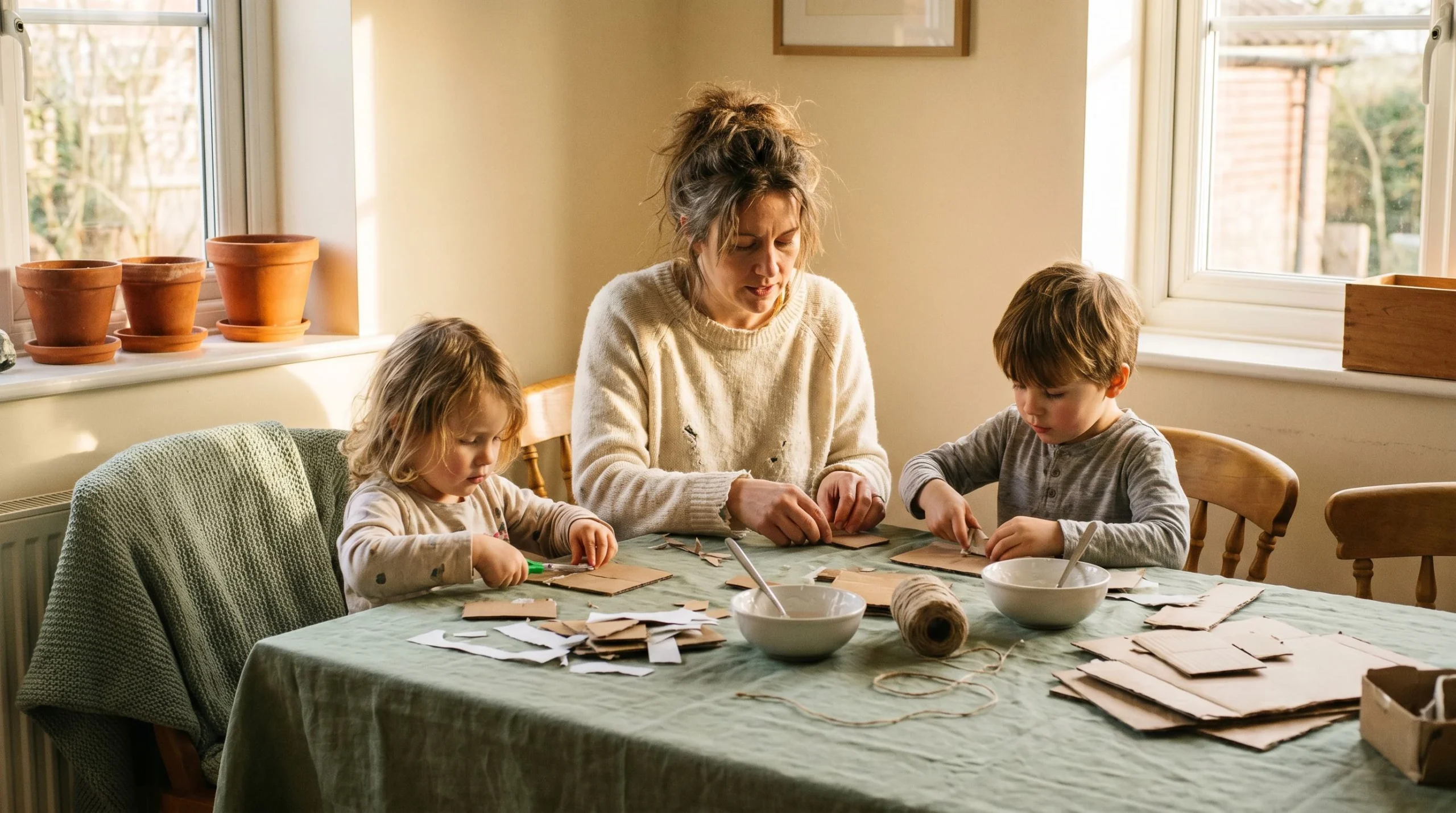
A no-spend month with kids sounds like a cute idea until your six-year-old asks for a Slurpee at the gas station and your toddler dumps a full cup of milk on the floor at 7 a.m. It can absolutely work, and here’s a realistic look at how it goes, week by week. The wins, the meltdowns, and the $612 a month like this can free up.
If you’re a parent staring at your bank app wondering where the money went again, I see you. I’m not going to tell you to “just stop buying things,” because kids don’t care about your budget. Instead I’ll walk you through a realistic four weeks, week by week, with sensible rules, what a typical month might cost, and the stuff I’d watch out for.
Why a no-spend month with kids is worth trying in the first place
Add up your “little” spending, the $6 here, the $14 Target run, the drive-thru on the way home from swim, and it can easily come to almost $700 in a single month. None of it feels like a big purchase. That’s exactly the problem.
If you’ve done a regular reset before, you already know the basics from my guide to running a realistic no-spend month. But doing it with a 3-year-old and a 6-year-old in the house is a completely different sport. Here’s what makes it worth doing:
- The drip is the budget killer. Groceries are usually fine. It’s the $4 to $18 impulse buys, dozens of them, that can add up to roughly $680 in a single month.
- It helps kids see “no” as normal. Not scary, not a punishment. Just a regular word that doesn’t mean you’re broke.
- A real goal makes it stick. Say you’re $400 short for summer camp, and you want that money by the end of the month instead of charging it.
- It quiets the guilt. Every “treat” comes with a little voice saying you should’ve saved it. A reset turns that voice off.
So on the first of the month, tape a sheet of paper to the fridge, write your rules in marker, and let the kids decorate it with stickers. That little ritual matters more than you’d expect.
The rules to set (and the ones worth bending for the kids)
A no-spend month is not a no-money month. You still pay rent, utilities, insurance, gas, and regular groceries. The challenge is only about discretionary spending, the stuff you choose in the moment.
Here’s a solid list to write on the fridge:
- No takeout, no coffee runs, no drive-thru. Cook and make coffee at home. For most families this is the biggest leak.
- No “just browsing” at Target, Amazon, or the mall. If you didn’t plan it, you don’t buy it.
- No new toys, clothes, or books unless something breaks or a kid grows out of it. Hand-me-downs and the library count.
- Groceries get a hard cap of $150/week. Real food, not snack-aisle impulse buys.
- Three “kid exceptions” for the whole month. Birthday party gift, a school field trip, and one small planned treat. I’ll explain why below.
That fifth rule is the one that saves the entire challenge. Trying to white-knuckle a no-spend month with kids and zero flexibility is how you quit on day four. Budget three small exceptions on purpose, say a $15 birthday gift, a $9 field-trip lunch, and one $12 movie-night-at-home treat, so the kids never feel punished and you never feel like a failure for “breaking the rules.” Planned exceptions aren’t cheating. They’re the difference between finishing and rage-quitting.
The goal was never zero fun. It was zero mindless spending. Those are very different things.
Week 1: the hardest week, and the milk-on-the-floor mornings
Week one is the rough one, honestly. The first three days, every routine that used to involve buying something suddenly has a hole in it.
The classic breaking point is a milk morning. Toddler dumps the milk, you’re late, and your brain immediately goes “just hit the drive-thru, you’ve earned it.” That $11 breakfast is exactly the kind of autopilot spending you’re trying to catch. Make toast instead and eat it in the car. Nobody dies.
What a realistic week one costs and saves:
- Groceries: around $148. Just under a $150 cap, which is genuinely encouraging.
- Drive-thru/coffee avoided: about $64. That’s roughly four moments you’d normally have caved.
- Target trip skipped: ~$50. You need one thing (dish soap) and use what’s already at home instead.
By Sunday you can dodge roughly $114 in spending you’d never have noticed in a normal week. That number is what keeps you going.
Week 2: free fun, library hauls, and the boredom problem
By week two, the novelty wears off and the kids get bored. That’s the real test, because bored kids are expensive kids. That’s when the “can we just go to the store” requests start.
So build a little menu of free things to do, basically a parent’s version of my list of things to do instead of shopping when you’re bored. Here’s what tends to actually entertain little kids:
- Library day. Check out a stack of books and a couple of movies for $0. Many libraries also run a free Saturday craft hour.
- “Restaurant night” at home. The kids make menus and “serve” you spaghetti. Cost: ingredients you already have.
- Park scavenger hunt. Write a list of 10 things to find. It can kill two whole hours.
- Backyard movie night. A sheet, a blanket, popcorn from the pantry. This is the planned $0 version of your one treat.
In a good week two, groceries might come in around $142 with zero impulse buys. The boredom is real, but it turns out kids usually don’t need anything new. They need your attention, which is free and is the whole point.
Week 3: the birthday party that tested everything
Week three is where most no-spend challenges fall apart, because real life shows up. Often it’s a classmate’s birthday party with a gift to buy.
This is exactly what those planned exceptions are for. You use one of your three: a $15 gift from the dollar-store craft section plus a card you make at home. The autopilot version of this trip spends $35 and grabs a “little something” for your own kids while you’re there, out of guilt. The no-spend version spends $15 and walks straight out.
This is also where the first real frustration hits. A neighbor invites you to a $25-per-person trampoline place and you have to say no. You feel like the cheap parent for about an hour. Then you remember you’re saving for camp, tell your kid the truth in a kid-sized way, “we’re saving up for something bigger,” and they’re completely fine. Kids handle honesty better than we expect.
Week three numbers:
- Groceries: $151 (a dollar over, and that’s fine).
- Birthday gift: $15 (planned exception #1).
- Trampoline outing declined: $75 saved for a family of three.
Week 4: coasting, the field trip, and counting the savings
By week four, the no-spend month basically becomes the new normal. The autopilot urges quiet down, and you stop reaching for your phone to “quickly order” things. That shift is the best part of the whole thing.
Exception #2 goes to a school field trip ($9 for a sack lunch you can’t pack) and exception #3 often never gets used at all, because the backyard movie night already covered the treat. So you come in under your own plan.
Here’s what the full month can add up to:
- Total discretionary spending: $39 (the $15 gift, $9 field trip, and $15 of small in-between stuff).
- A typical month before: ~$680. So the real swing is about $641.
- Groceries: about $583 for the month vs. roughly $710 before, mostly from skipping snack-aisle grabs.
- What you can move to savings: $612. Enough to cover camp in full, in cash, with $212 left over.
These numbers aren’t here to impress anyone. They’re here because “spend less” is vague and useless, but “$612 you can see in your account” is a feeling. That feeling is what makes you want to do it again.
How do you handle grandparents who keep buying the kids stuff?
Nobody warns you about this part. Two weeks in, a grandparent shows up with a $40 Target bag of “just a few things” for the kids, and another slips your six-year-old a $20 bill at Sunday dinner. Your own spending is locked down tight. The grandparents are a whole different leak, and an emotional one.
Here’s the thing to make peace with first. Their money is theirs to spend, and gifts from people who love your kids aren’t the enemy. The problem isn’t the generosity. It’s that a constant stream of new stuff teaches kids that “new toy” is the default setting, which is the exact habit you’re trying to break in your own house. So you don’t ban it. You redirect it.
- Give them the goal. Tell the grandparents, gently, that you’re saving for summer camp this month and ask if any “treat” money could go into the camp jar instead. A grandparent who puts $30 in the jar usually loves being part of the goal more than the toy aisle.
- Offer a list of $0 gifts. A sleepover at Grandma’s, a baking afternoon, a trip to the library together. A grandparent who adopts the baking idea makes it their thing. It costs nothing and the kids talk about it more than any toy.
- Let one planned splurge stand. Stop policing every single gift. When a grandparent wants to buy rain boots the kids actually need, say thank you and mean it. Fighting every dollar turns a money reset into a family fight.
The easy mistake is waiting until week two to say anything, so the first $60 of grandparent spending happens before you set any expectation. Say it on day one, kindly, before the bags start arriving. Once you frame it as “help us hit our camp goal” instead of “please stop spoiling them,” grandparents tend to get on board, and that camp jar can end the month $50 heavier than planned. The people who love your kids usually want to be part of the win, not the problem.
What to do differently on your next no-spend month with kids
A no-spend month with kids can teach you more in four weeks than a year of budgeting apps. A few things are worth getting right from the start:
- Prep freezer meals before day one. The drive-thru urge is strongest when you’re hungry and tired. Two or three ready-to-heat dinners will save you on the worst nights.
- Tell the kids the goal upfront. Once a child knows you’re saving for camp, they tend to become a little accountability partner and start catching your impulse buys for you.
- Plan four exceptions, not three. Three is usually enough, but one more cushion takes the low-grade stress off completely.
- Keep a running “saved” tally on the fridge. Watching the number climb was more motivating for all of us than any rule.
If you want a softer on-ramp before going all in, you can start with a no-spend week, or look at loosening the rules into a longer reset. I broke that down in my post on realistic no-buy year rules. There’s no prize for being extreme. There’s only the version you can actually finish.
Cozy tip: Don’t try to plan the whole month perfectly before you start. Just tape one sheet of paper to the fridge with three rules and start tomorrow. Grab my free printable no-spend tracker, let your kids decorate it with stickers, and color in a box every day you stick to it. Small and visible beats perfect and overwhelming every single time.
A No-Spend Month With Kids: Week-by-Week Snapshot
A no-spend month feels lighter when you can see the whole arc at a glance. Here is a sample week-by-week plan with a free family activity and a simple focus for each stretch.
| Week | Focus | Free family activity |
|---|---|---|
| Week 1 | Set the rules together | Make and decorate the no-spend tracker |
| Week 2 | Shop the pantry & freezer | Backyard picnic or living-room camp-out |
| Week 3 | Beat the mid-month slump | Library trip and a homemade movie night |
| Week 4 | Coast to the finish | Nature walk and a “use it up” cooking challenge |
Common mistakes during a no-spend month with kids
- Making it feel like punishment. Kids mirror your tone. Framing it as a game with stickers and small wins keeps everyone on board.
- Forgetting to define exceptions. Medicine, a school fee, a birthday, these need to be decided up front so they do not feel like cheating.
- Going it alone. If the kids do not know the plan, every store trip is a battle. Bring them into the why on day one.
Frequently Asked Questions
How do you do a no-spend month with kids without making them feel deprived?
Frame it as a fun challenge, not a punishment, and build in a few planned exceptions like a birthday gift or one small treat. Taping the rules to the fridge and letting the kids decorate the tracker makes it feel like a game you’re playing together. When you have to say no to a paid outing, give the honest reason, that you’re saving for camp, and kids tend to handle it just fine.
What still counts as essential spending during a no-spend month?
Rent, utilities, insurance, gas, regular groceries, prescriptions, and anything safety-related still get paid normally. A no-spend month only freezes discretionary spending: takeout, impulse buys, new toys, coffee runs, and “just browsing” trips. The goal is to cut mindless spending, not to skip your real bills or let a kid go without something they genuinely need.
How much money can a no-spend month with kids actually save?
In a month like this, you can save about $612, the difference between $39 of discretionary spending and roughly $680 in a typical month before. Your number depends on how much “little” spending you do now, so track one normal month first to find your real leak. For most parents, the impulse buys and takeout add up to far more than they’d guess.
What do you do with bored kids when you can’t buy anything?
Lean hard on free fun: library days, park scavenger hunts, backyard movie nights, “restaurant night” at home, and craft hours your local library or community center runs for free. Keep a short menu of go-to ideas on the fridge so you’re not inventing entertainment on the spot. Most of the time kids don’t want a new toy, they want your attention, which costs nothing.
How do you handle birthday parties and school costs during a no-spend month?
Plan for them as exceptions before you start instead of pretending they won’t happen. Budget three small exceptions for the whole month, a $15 birthday gift, a $9 field-trip lunch, and one planned treat, so real life doesn’t blow up the challenge. Planned exceptions aren’t cheating; they’re what keeps you from quitting when an invitation lands mid-month.
Grab my free Monthly Budget Template
The same cozy spreadsheet I use to track every dollar — sinking funds, bills, and savings, all in one place. Join the newsletter and I’ll send it straight to your inbox.
No spam, ever. Unsubscribe anytime. — Nora
Keep reading — more on No-Spend Challenges