
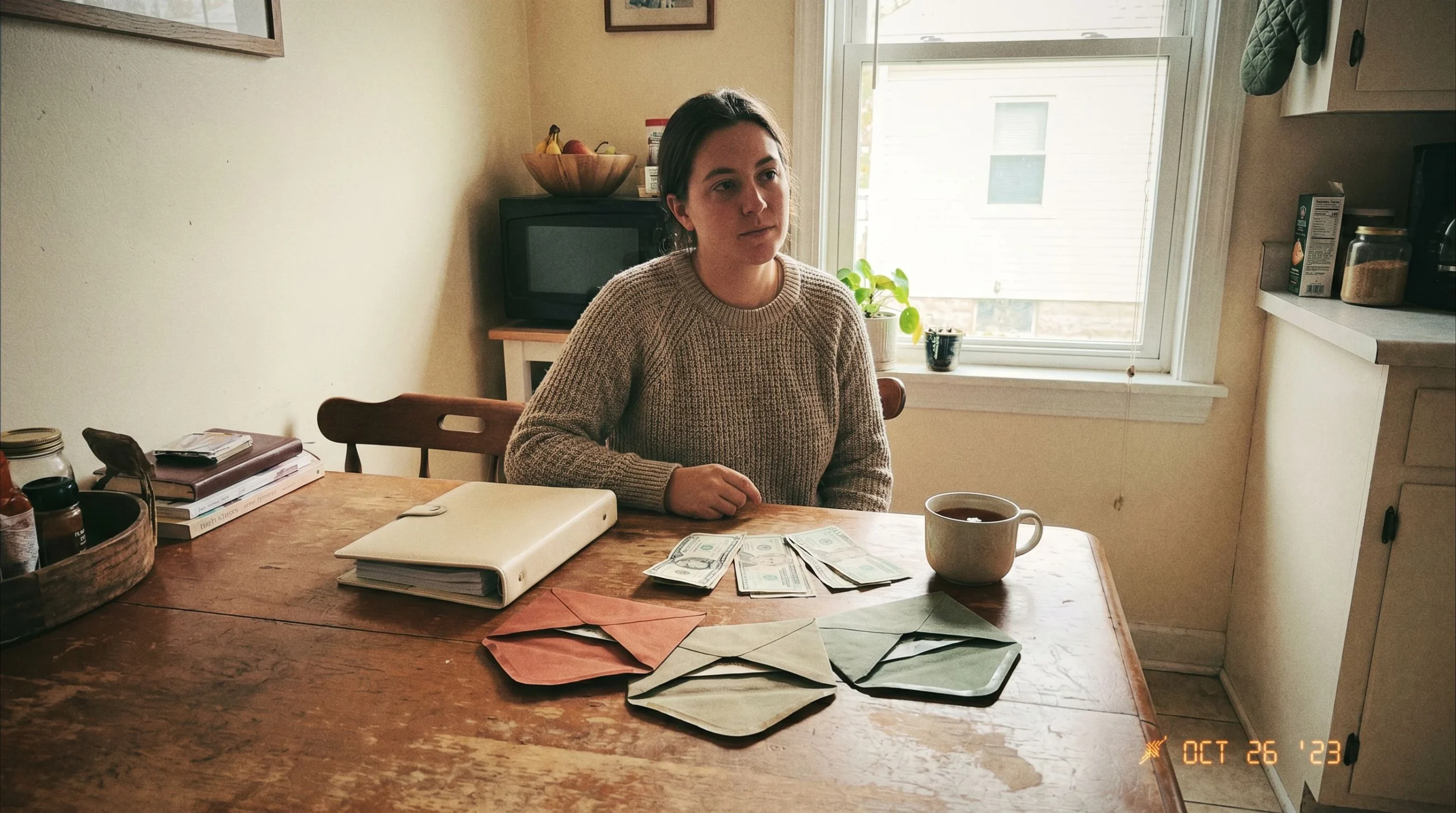
Cash stuffing for beginners is the simple envelope habit that finally made my money feel calm instead of confusing. I’ll be honest. I avoided it for years because it sounded fussy and a little extra. Then I gave it one honest month, and that’s what got me hooked.
New to all of this? Cash stuffing is just one piece of the puzzle. If you want the big-picture walkthrough first, start with my complete beginner’s budgeting guide, then come back here to set up your envelopes.
If you’ve ever opened your banking app on a Tuesday and had no idea where $300 went, I see you. I’ve been there more times than I’d like to admit. So this is the friendly, no-shame walkthrough I wish someone had handed me: what cash stuffing actually is, the exact steps I use, the categories I’d start with, and realistic numbers for a typical first month. No lecturing. Just what worked.
What cash stuffing actually is (in plain English)
Cash stuffing is a budgeting method where you pull out physical cash, split it into labeled envelopes by category, and spend only what’s in each envelope until your next paycheck. When the “Groceries” envelope is empty, you’re done buying groceries for the period. That’s the whole idea.
It’s a fresh name for the old envelope system your grandma probably used. TikTok made it cute again, with binders and those oddly satisfying money-folding videos. The aesthetic is new. The math is decades old.
Here’s why it works so well when you’re just starting out:
- It makes money physical. People consistently spend more with cards than with cash, and I’m no exception. Switch your “fun money” to, say, a $120 envelope and you genuinely slow down at the register.
- It gives you a hard stop. A debit card lets you drift $40 over without blinking. An empty envelope does not negotiate.
- It’s visual. You can see your last $18 for the week. No app, no login, no midnight mental math.
- It builds awareness fast. Within two weeks you’ll know exactly which category you’ve been quietly blowing. For a lot of people it’s takeout, often by around $90 a month.
Say you stuff $1,400 across seven envelopes in a first month and end with $112 left over. That $112 is the kind of moment where, maybe for the first time in ages, you have money “left” instead of money “missing.” That feeling is the whole point.
Cash stuffing for beginners: the step-by-step method I use
People overcomplicate this part, so let me keep it gentle. Cash stuffing for beginners doesn’t need a label maker or a $40 binder. It needs your take-home pay, a few envelopes, and about twenty minutes. Here’s the exact order I do it in.
- Write down your real take-home pay. Not your salary. Your actual deposit. Say it’s $1,750 every two weeks, so you plan in two-week chunks.
- List your fixed bills first. Rent, car, phone, insurance. I leave these in checking and pay them digitally. Cash stuffing is for the spending that wiggles, not the bills that don’t.
- Pick your cash categories. Start with 4 to 6. Not fifteen. Mine are groceries, gas, eating out, household, fun, and a tiny “oops” buffer.
- Assign a dollar amount to each. Look at your last two months of spending and be realistic, not aspirational. I gave groceries $400, gas $120, eating out $100, household $60, fun $80, and a $40 buffer per pay period.
- Get the cash from the bank. Ask for a useful mix of bills. I take mostly twenties plus a few fives and ones so I can split things exactly.
- Stuff and label the envelopes. Count it out loud. Seriously. It helps it sink in.
- Spend only from the envelope. Buy groceries, the grocery cash goes. When it’s empty, it’s empty until payday.
- Reconcile on payday. Whatever’s left, I either roll forward or move to savings. Leftover money is a win, not a reason to splurge.
That’s it. The system is boring on purpose, and boring is exactly what makes it stick. My first run through all eight steps took 22 minutes. Now it takes about 10.
How much cash should I actually start with?
This is the question I get most: how much should I pull out? The honest answer is to start small enough that it doesn’t scare you. You can always add more next pay period.
When I walk a friend through cash stuffing for beginners, I tell them to start with their three leakiest categories. For most people that’s food, fun, and “miscellaneous chaos.” Here’s a sample first stuff for someone bringing home around $1,500 every two weeks:
- Groceries: $350. The category almost everyone lowballs. Round up, not down.
- Eating out: $80. Keep it generous at first so you don’t feel deprived and quit by day three.
- Fun and personal: $100. Coffee, nails, a movie, a small treat. This is the anti-shame envelope.
- Buffer: $50. For the random parking garage, the birthday gift you forgot, the prescription co-pay.
That’s $580 in cash for two weeks, with everything else still running through checking. Manageable. It’s easy on a first attempt to overstuff eleven envelopes with $1,400 and feel overwhelmed by Wednesday. Four envelopes would be a lot kinder to a beginner.
You don’t have to be good with money to start. You just have to be willing to watch where it goes for one month.
The mistakes I made my first month (so you can skip them)
I want you to start ahead of where I did, so here’s where I tripped. None of these are failures. They’re just speed bumps.
- Too many envelopes. Eleven categories meant constant shuffling. Fewer envelopes, bigger buckets, less stress.
- Underfunded groceries. Fund it at $250 and you might run dry with five days left. That’s not being bad at budgeting. The number was just wrong, and it’s an easy fix the next round.
- No small bills. I’d have a $20 in the gas envelope for a $14 fill-up and no way to make change. Now I keep fives and ones on hand.
- Treating leftovers as “free.” That kind of $112 surplus can easily turn into a random Target run. Better to send leftovers straight to your sinking funds.
- Too much cash at home. Stick to one pay period’s worth. There’s no reason to have $2,000 sitting in a drawer.
One more honest thing. I missed a week. Life happened, I forgot to restuff, and I used my card. I didn’t quit. I just restuffed the next Monday. Consistency beats perfection every single time.
What to keep in cash vs. what to keep digital
Cash stuffing doesn’t mean living in 1995. Some money is genuinely better off in your bank account, and mixing the two isn’t cheating. It’s smart.
Here’s my simple split:
- Keep in cash: the flexible, tempting, easy-to-overspend stuff. Groceries, dining, fun, beauty, household odds and ends.
- Keep digital: fixed bills, rent, subscriptions, anything on autopay, and anything you’d never impulse-buy. Your emergency fund belongs in a savings account earning interest, too.
In a typical setup, about $580 to $700 per pay period lives in envelopes. The other $2,100 or so runs through checking for bills and savings. If carrying cash makes you nervous (totally valid), you can run this same system with separate bank “buckets” instead. I break that down in my guide to digital cash stuffing without physical cash, which is what I switch to during travel months.
Cozy tip: Don’t try to perfect every category on day one. Start with just three envelopes this payday, food, fun, and a buffer, and add more next month once it feels natural. If you want a head start, grab my free printable envelope labels and let yourself begin small. Small and consistent always beats big and abandoned.
Picking your first categories without overthinking it
If choosing categories feels paralyzing, breathe. You can change them every single payday. There are no money police.
Most beginners do great with these five buckets to start:
- Groceries. The big one. Fund it generously.
- Dining and coffee. Keep it separate from groceries so you can see the real number.
- Transportation. Gas, parking, the occasional rideshare.
- Fun and personal. Your guilt-free joy money.
- Buffer. For the unpredictable little stuff.
As you get comfortable, you might split things out further or add seasonal envelopes for holidays and back-to-school. I go deep on how to choose and size your buckets in my post on how many cash envelope categories you actually need. And if you want the full library of methods, my cash stuffing category keeps every tutorial in one place.
Cash stuffing on an irregular or biweekly paycheck
Here’s the part most beginner guides skip, and it tripped me up early. What if your income isn’t the same every month? Freelancers, tipped workers, commission folks, I see you.
My fix is to stuff off your lowest recent paycheck, not your best one. I average my last three pay periods, then fund envelopes from the smallest of the three. On a big month, the extra goes to savings or next month’s stuffing fund instead of inflating my spending. It feels conservative. That’s the point. You never want your grocery envelope to depend on a tip night that didn’t happen.
If you’re paid biweekly like me, remember two months a year have three paychecks. Treat that third check as a no-stuff bonus and send it straight to a sinking fund. That one habit can quietly fund an entire holiday budget.
Is cash stuffing right for you? An honest gut-check
I love this method, but I’d be a bad friend if I pretended it’s perfect for everyone. So let’s be real about fit.
It tends to work beautifully if:
- You overspend with cards. If tapping your phone feels like free money, physical cash helps. For many people it trims around $90 a month off takeout almost instantly.
- You’re a visual or hands-on learner. Watching the money shrink hits different than a number on a screen.
- You want out of the paycheck-to-paycheck cycle. The hard stop forces awareness fast.
It might not be your match if you lean on credit-card rewards for everything, if your area is mostly cashless, or if carrying cash genuinely stresses you out. None of that makes you bad with money. It just means a digital version might fit you better. For trustworthy, jargon-free help building any budget, the free tools from the Consumer Financial Protection Bureau (CFPB) are a genuinely solid, unbiased place to start, and I send people there all the time.
The best budgeting method is the one you’ll actually keep doing. For me, that turned out to be a stack of plain white envelopes and a cheap pen. Six months in, it’s common to keep $600 or more you would’ve otherwise spent without noticing. Honestly, the calm is the bigger win.
Wondering if this is just a trend? Here is how common cash stuffing actually is, with real survey numbers.
Your first week of cash stuffing, step by step
Cash stuffing feels intimidating until you see it as a few small actions spread across a week. Here’s a beginner-friendly first-week plan you can follow without overthinking any single day.
| Day | What to do | Why it matters |
|---|---|---|
| Day 1 | List last month’s real spending, no judging | Your categories should match your life, not a template |
| Day 2 | Pick 4 to 6 envelope categories only | Fewer envelopes are far easier to actually keep up |
| Day 3 | Decide an amount for each envelope | A clear limit is what makes the cash “run out” on purpose |
| Day 4 | Withdraw the cash and label the envelopes | Physical cash is what creates that “this is real” feeling |
| Day 5 | Use only envelope cash for a small shop | A low-stakes test run before you trust it with everything |
| Day 6-7 | Check what’s left and adjust next week | The first round is data, not a pass-or-fail grade |
Common beginner cash stuffing mistakes
- Starting with too many envelopes. A dozen categories feel organized for a day, then become a chore. Begin with the handful where your money actually leaks and add more only if you miss them.
- Stuffing with money you need for bills. Cash stuffing is for spending money, not rent or the electric bill. Pay fixed bills first, then stuff what’s genuinely left.
- Quitting after one messy week. The first week is almost never tidy, and that’s normal. Treat the leftover or shortfall as feedback and reset the amounts, don’t scrap the whole system.
Frequently Asked Questions
Is cash stuffing a good idea for beginners?
Yes, and it’s one of the friendliest methods to start with because it’s so visual. Cash stuffing for beginners works best when you keep it simple: pick three to five categories, fund them realistically, and spend only from the envelope. The hard stop of an empty envelope built my awareness faster than any app ever did.
How much money should I start cash stuffing with?
Start with one pay period’s worth of flexible spending, not your whole paycheck. For most beginners that’s roughly $500 to $700 split across food, fun, and a small buffer. Keep your fixed bills in checking on autopay. You can always bump the amount up next payday once it feels comfortable.
What categories should beginners use for cash stuffing?
Keep it to four or five buckets at first: groceries, dining out, transportation, fun, and a miscellaneous buffer. Too many envelopes early on gets overwhelming, which is the number-one mistake I see. You can always split categories out later once the basic system feels natural after a month or two.
Does cash stuffing actually save you money?
For most people, yes, mainly because spending physical cash feels more real than tapping a card, so you naturally slow down. Over a first six months it’s common to keep $600 or more you’d otherwise have spent without noticing. The savings come from awareness and the hard stop, not from any trick, so your results depend on how consistently you stick with it.
What do I do when a cash envelope is empty?
When an envelope is empty, you’re simply done spending in that category until your next payday. That’s the whole point, and where the magic happens. If you truly need more, borrow from your buffer envelope instead of reaching for a card, then nudge that category’s amount up next pay period so the number fits your real life.
Grab my free Monthly Budget Template
The same cozy spreadsheet I use to track every dollar — sinking funds, bills, and savings, all in one place. Join the newsletter and I’ll send it straight to your inbox.
No spam, ever. Unsubscribe anytime. — Nora
Keep reading — more on Cash Stuffing