
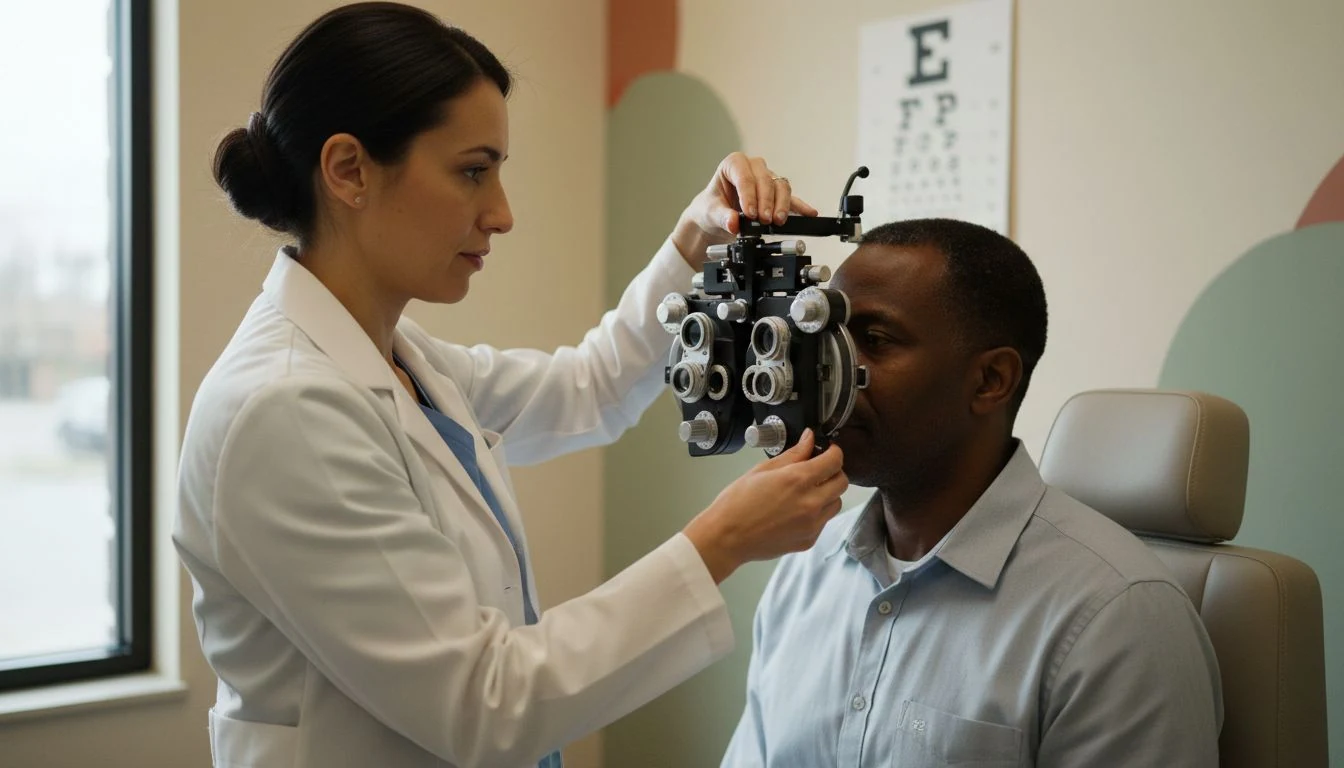
How much is an eye exam was a question I kept answering with “later,” because my glasses still technically worked. They were four years old, the left lens had a scratch right where I read, and I got headaches every afternoon at my desk.
When I finally went, the exam was the easy part of the bill. The glasses were the part I hadn’t planned for. Below: what an eye exam costs in 2026 with and without insurance, what glasses and contacts add, the free prescription rule few people know about, and why fall is the time to use vision benefits you already pay for.
How much is an eye exam without insurance?
I couldn’t find a free national price survey for eye exams, so I went looking for the most recent prices someone collected by hand. The best one I could read is from Clark.com, which called optical centers in January 2026 in three cities: Lexington, Kentucky; Atlanta; and Denver.
Their quotes for a basic comprehensive exam with no insurance:
- The cheapest quote: $79
- The most expensive quote: $128
- The average across the stores they called: about $100
- A contact lens fitting on top of the exam: another $50 to $70
Those were big-box and warehouse-store optical centers, the budget end of the market. A private optometrist or an ophthalmologist can charge more, and prices shift by city. So when a friend asks me how much is an eye exam without insurance, I say “around $100 at a store optical center, often more at a private office, and call first.”
Some good news: the Bureau of Labor Statistics tracks a price index for eyeglasses and eye care, and it rose only about 18% between August 2016 and August 2026. Overall prices rose about 39% in those ten years.
What the exam price usually doesn’t cover
I budgeted $100, walked in, and found out “eye exam” can mean a few different things.
A comprehensive exam checks your prescription (the “one or two?” part, called a refraction) and the health of your eyes. A few things often get billed separately:
- A contact lens fitting, which Clark.com put at $50 to $70 extra on average.
- Optional add-ons like retinal photos. Ask the price before you say yes.
- The glasses or contacts themselves, the big number.
The chart at school or the DMV doesn’t count. The American Optometric Association says a vision screening can’t be relied on to give the same results as a full exam.
I went in for a $100 exam and walked out having spent $330, because the glasses I tried on were the ones in my hand when they asked “ready to order?”
How much is an eye exam with vision insurance?
Often a small copay, or nothing. Most vision plans cover one routine exam a year plus an allowance toward frames or contacts. Log into your plan and find the exam copay, the frame allowance, and how often each renews.
Many vision plans run on a calendar year, and unused benefits don’t roll over. If your plan resets January 1 and you haven’t had this year’s exam, that’s coverage you paid for in premiums and will lose on December 31. It’s the same reason I tell people to book their second dental cleaning in the fall. Book in October, not the week before Christmas when every office is full of people doing the same math.
Two more year-end checks:
- A health FSA can pay for exams, glasses and contacts. FSA money is use-it-or-lose-it unless your employer offers a grace period or carryover, and the IRS caps the carryover at $680 for 2026 plans. A pair of glasses is a very reasonable way to spend down a balance.
- An HSA pays for the same things and doesn’t expire.
The IRS lists eye exams, eyeglasses and contact lenses needed for medical reasons as medical expenses in Publication 502, which is why they usually count for FSA and HSA spending. Vision is also usually a separate plan from your medical coverage. If you’re comparing the medical side too, I broke down what health insurance costs per month in its own post.
How much is an eye exam on Medicare?
All of it, in most cases. According to Medicare.gov, Original Medicare doesn’t cover routine eye exams for glasses or contacts, so you pay the full cost. It also usually doesn’t cover glasses. The main exception is after cataract surgery with an implanted lens, when Part B covers one pair of glasses with standard frames (or one set of contacts), and you pay 20% of the approved amount after the Part B deductible. If you’re helping a parent budget, put their eye exam and glasses in the plan as out-of-pocket unless their specific plan says otherwise.
Glasses and contacts: where the real money goes
The exam is usually the smaller number. The glasses are where my budget fell apart.
The most useful price data I found is from 2019. In a Consumer Reports reader survey that year, people who bought glasses in a store and paid out of pocket spent a median of $234 a pair. People who bought online paid a median of $91.
I adjusted both with that same BLS eyeglasses and eye care index (up about 15% from August 2019 to August 2026). That gives me these working estimates for today:
- A pair bought in a store: about $268
- A pair bought online: about $104
Treat those as budgeting estimates. Progressive lenses, thinner high-index lenses and fancy coatings push the price up fast. A plain single-vision pair with basic frames can come in well under both numbers.
Contacts are their own line: you buy lenses all year, and the cost depends on the type you wear. Price your exact brand for a full year before you decide contacts are “cheaper” than glasses. For me they weren’t.
If this feels like a lot, you have company. The CDC reports that in 2017, more than 8 million adults who needed glasses, about 1 in 11, said they couldn’t afford them. Most of us were never taught to plan for this cost, and that’s on nobody’s character.
Your prescription is yours (and that rule saves real money)
This is the tip I wish I’d known at 22. Federal rules from the FTC say your eye doctor has to give you a copy of your glasses prescription after the exam, whether you ask for it or not. Same for contacts once the fitting is done.
What that means for your wallet:
- They can’t charge you an extra fee for the copy.
- They can’t require you to buy your glasses or contacts from them.
- They can’t make you sign a waiver to get it.
- A contact lens prescription has to be good for at least a year, unless there’s a medical reason to make it shorter.
Get the exam wherever you like, then shop the prescription. On my last pair I took the paper home, compared prices online that night, and paid about $160 less than the pair I almost bought in the office. Nobody pressured me. I hadn’t realized I was allowed to leave with the paper.
One caution: online glasses work great for simple prescriptions. If yours is strong or you need progressives, a good in-person fitting can be worth paying for.
How I budget for my eyes now
After that first surprise bill, I stopped treating eye care as a someday expense. It’s a line in my sinking funds now, right next to the dentist. My setup:
- Know how often you actually need to go. The AOA’s exam schedule says adults 18 to 64 at low risk should go at least every two years, at-risk adults at least yearly, and everyone 65 and up yearly. Kids should have an exam before first grade and yearly after that.
- Price the full visit. Call and ask for the cash price of the exam plus a contact fitting if you wear contacts. Write that number down.
- Add your glasses or contacts. Use a real quote, or the estimates above if you’re starting from zero.
- Divide by the months until your next exam. An exam every two years plus glasses is a much smaller monthly number than people expect.
- Put an October reminder on your calendar. Mine says “vision benefits used? FSA balance?” It takes two minutes.
- Keep your prescription on your phone. Take a photo of it at every exam so you can shop around without calling the office.
I still spend money on my eyes. I’m just not surprised by it anymore. My afternoon headaches stopped about a week after the new glasses, and that $100 exam is the best money I’ve spent on my health in a while.
What a year of eye care costs, three ways
A worked example with the numbers above. The exam uses the roughly $100 average from Clark.com’s January 2026 price calls, and the glasses use the Consumer Reports 2019 medians adjusted by the BLS index to August 2026. Your area and your prescription will change these.
| Scenario | What’s included | Estimated total | Monthly set-aside (yearly exams) | Monthly set-aside (exam every 2 years) |
|---|---|---|---|---|
| Exam only | Comprehensive exam, cash price | $100 | $8 | $4 |
| Exam + contact fitting | Exam + fitting fee (lenses not included) | $150 to $170 | $13 to $14 | $6 to $7 |
| Exam + glasses online | Exam + one pair bought online | $204 | $17 | $9 |
| Exam + glasses in a store | Exam + one pair bought in a store | $368 | $31 | $15 |
Compare the last two rows. Same exam, same eyes, and the store pair costs about $164 more. Shopping your prescription is where most of the savings in this table come from.
Common mistakes when budgeting for eye care
- Budgeting for the exam and forgetting the glasses. The exam is often the smaller half of the bill, so price both before you book.
- Letting vision benefits expire. If your plan resets January 1, an unused exam or frame allowance is money you already paid in premiums.
- Buying in the exam room by default. You have a legal right to your prescription, so it’s fine to take it home and compare prices first.
Cozy tip: this week, open your vision plan (or your FSA) and check one thing: have you used this year’s exam? If not, book it before the holiday rush. Then add a small “eyes” line to your sinking funds so the next pair of glasses is already paid for. The free monthly budget printable has a sinking fund section that fits it perfectly, and you’ll find more setups like this under budgeting.
Frequently Asked Questions
How much is an eye exam at a store optical center?
In Clark.com’s January 2026 calls to store optical centers in three cities, quotes ran from $79 to $128 without insurance, averaging about $100. A private office may charge more, so ask for the self-pay price.
Is a contact lens exam more expensive than a regular eye exam?
Usually, yes. A contact lens fitting is typically added on top of the regular exam. Clark.com put that extra fee at about $50 to $70 on average, and the lenses themselves are a separate cost.
Does Medicare pay for eye exams?
Original Medicare doesn’t cover routine eye exams for glasses or contacts, so you pay the full cost. Glasses usually aren’t covered either, except one pair with standard frames after cataract surgery with an implanted lens. Some private plans add vision benefits.
Can my eye doctor refuse to give me my prescription?
No. Under the FTC’s Eyeglass Rule and Contact Lens Rule, the prescriber must give you a copy after the exam (or after the contact lens fitting), without an extra fee. They also can’t require you to buy glasses or contacts from them.
How often should adults get an eye exam?
The American Optometric Association recommends at least every two years for adults 18 to 64 at low risk, at least yearly for at-risk adults, and yearly for everyone 65 and older. Your eye doctor may suggest a different schedule.
I keep a running page of budgeting statistics built from sources like these. One more for perspective: the CDC estimates about 93 million US adults, roughly 4 in 10, were at high risk for vision loss in 2017, and about 40% of them hadn’t seen an eye doctor in the past year.
Grab my free Monthly Budget Template
The same cozy spreadsheet I use to track every dollar — sinking funds, bills, and savings, all in one place. Join the newsletter and I’ll send it straight to your inbox.
No spam, ever. Unsubscribe anytime. — Nora
Keep reading — more on Budgeting Methods