
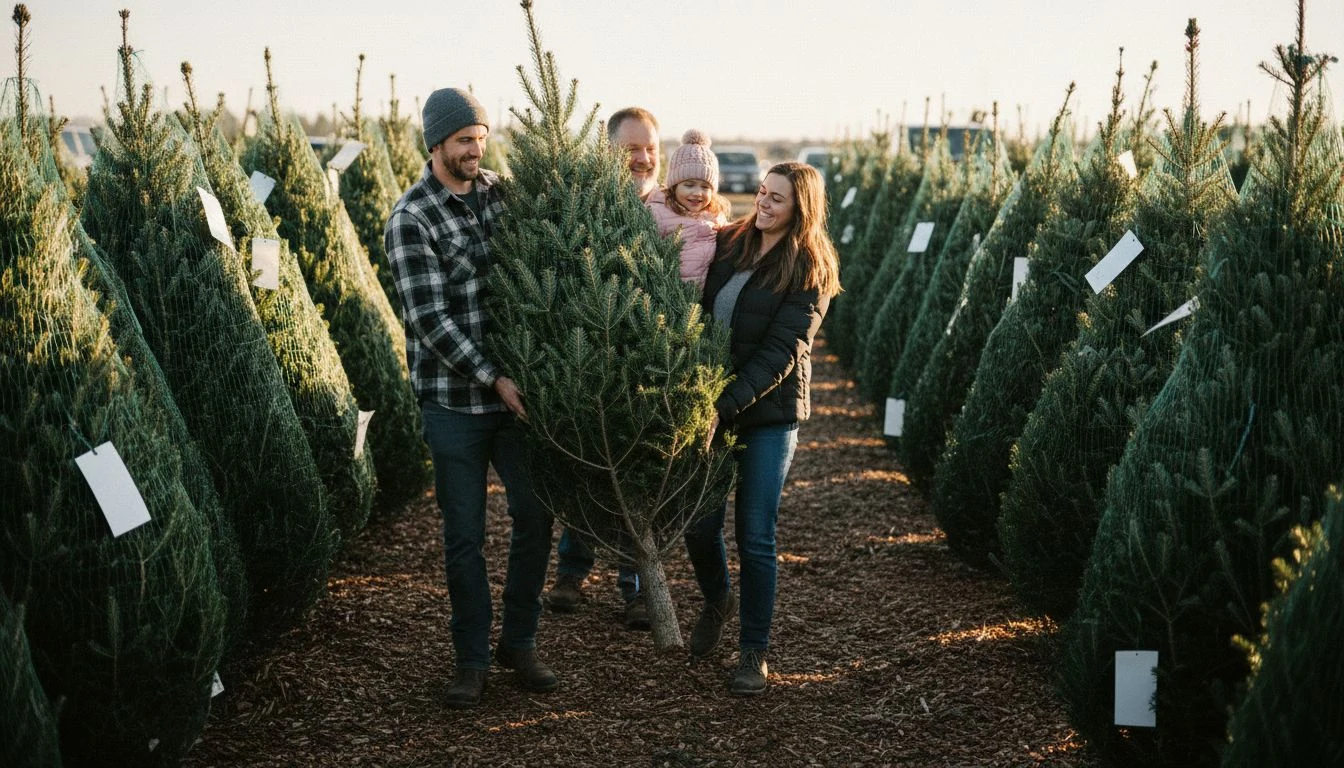
How much does a Christmas tree cost? The latest forecast I could find, from Finder’s analysis of National Christmas Tree Association surveys, put a real tree at about $84 and an artificial one at about $126 for the 2025 season. Nobody has published a solid 2026 number yet, so I’d budget a little above those. And here’s what changed my mind about the whole real-versus-fake fight: the sticker price is the wrong number to compare.
A real tree is a yearly bill. An artificial tree is a one-time bill you spread over however many Christmases it survives in your closet. So this post gives you the current prices, the per-year math at three price points, and the extras that quietly push the tree line past your budget. I’m a cash envelope person, which means the tree gets its own envelope, and I’d like you to know what to put in yours before you walk onto the lot.
How much does a Christmas tree cost right now?
The cleanest national numbers come from Finder’s Christmas tree cost analysis, updated in December 2025. They’re modeled forecasts built on National Christmas Tree Association survey data, so read them as a good estimate, not a price tag:
- Real tree, 2025 forecast: $83.87, up about $4.56 from 2024.
- Artificial tree, 2025 forecast: $126.20.
- Artificial tree, with tariff pressure: Finder notes the American Christmas Tree Association’s estimate that prices were 10% to 15% higher last season, which would put the average near $145.
Those averages hide a huge range on the fake side. A large, realistic pre-lit tree costs far more than a small tabletop one. 6abc reported in November 2025 that, according to American Christmas Tree Association projections, a $299 tree from 2024 could reach $359 in 2025.
On the real side, the same report said 84% of surveyed wholesale growers weren’t planning to raise wholesale prices that season. I can’t tell you what your local lot will charge this year. Nobody can from a national survey. What I’d do is call or check one nearby lot now, and use the numbers here as a sanity check.
Real vs. artificial: the math that settles it for your budget
Here’s the question I’d ask: how many Christmases does the fake tree have to last before it beats buying real every year? It’s simple division, and the answer depends almost entirely on which artificial tree you’re looking at.
Using an $84 real tree as the yearly cost:
- A $126 artificial tree passes the real-tree spending in year two ($168 of real trees vs. $126).
- A $145 artificial tree also wins in year two.
- A $359 artificial tree needs five seasons ($420 of real trees vs. $359).
That’s the whole trick, and it’s why I don’t take a side. If you’ll use a modest artificial tree for years, it’s the cheaper choice by a lot. If you’re looking at a pricey pre-lit tree and you move every two years, a real one may come out ahead. Plus, you’re paying for what you enjoy, and if the smell of a fir in December is the best part of your winter, that’s a fine thing to put in the budget.
Divide the price of the fake tree by the real one. That’s how many Christmases it has to survive before you’ve saved a dollar.
How much does a Christmas tree cost per year? A worked comparison
The table below runs the numbers over seven Christmases. The tree prices come from the sources above. The extras are placeholders I picked to make the example concrete, so swap in your own.
| Option | Up front | Yearly add-ons in this example | Total over 7 years | Cost per Christmas |
|---|---|---|---|---|
| Real tree every year ($84) | $40 stand, once | $84 tree + $10 delivery or disposal | $698 | about $100 |
| Average artificial tree ($126) | $126 | $0, assuming you already have closet space | $126 | $18 |
| Average artificial with tariff bump ($145) | $145 | $0 | $145 | about $21 |
| Premium artificial ($359) | $359 | $0 | $359 | about $51 |
The gap is bigger than I expected when I first ran it. Seven years is my round number, so please don’t read it as a promise about how long any tree lasts. If the artificial tree dies after three, divide by three. Also, a $100-per-Christmas real tree can still be the right pick. It just shouldn’t surprise you.
Why a real tree costs what it does
The price makes more sense when you know how long the thing took to grow. The National Christmas Tree Association says a typical 6-to-7-foot tree averages about seven years in the ground, and it can take anywhere from 4 to 15. Someone’s been trimming and caring for your tree since before you bought your current phone.
Variety and height are the two things you can control at the lot. Taller trees cost more, and popular firs tend to carry a premium over pines at many lots. So the cheapest move usually isn’t a coupon. It’s choosing a foot shorter. Measure your ceiling and the spot before you leave the house, because nothing burns money like falling in love with an 8-footer under a 7.5-foot ceiling and paying to deal with it.
How much does a Christmas tree cost once you add the extras?
Ask how much does a Christmas tree cost and you’ll hear the price of the tree. The afternoon itself costs more. I keep an eye on these because they’re what turn an $84 decision into a $200 trip:
- The stand. You’ll need one sturdy enough to hold water for a real tree. It’s a one-time buy if you keep it.
- Delivery or roof tying. Some lots charge, and some do it free. Ask before you get to the register.
- Lights and ornaments. Pre-lit artificial trees skip the lights, but a first-time tree can mean starting from nothing. Pull down what you own before you shop.
- Disposal. The NCTA counts more than 4,000 local tree recycling programs, so check your town’s schedule before you pay anyone to haul it away.
- The impulse aisle. The wreath, the hot cocoa, the matching garland. Totally fine, and I’d give them their own number.
Cozy tip: Make a “tree” envelope today. Put in the price you decided on, plus 10%. When the lot asks about the wreath, you’ll know right away whether there’s room. Our free budget printable has a holiday page if you’d like to plan the rest of the season on paper.
How to pay less for your Christmas tree this year
None of these is complicated. They’re just easier to do if you decide before December 15. Here’s the order I’d go in:
- Set your number first. Decide what the tree gets from your total holiday budget. My guide to how much to spend on Christmas has a table by income if you haven’t picked a total yet.
- Measure your space. Ceiling height minus stand and tree topper. A shorter tree that fits beats a tall one you have to trim.
- Price two local options. A tree farm, a garden center, a home improvement store or a nonprofit lot can charge different prices for similar trees.
- If you’re going artificial, watch for sales. Run the division above before you get excited about a discount. A 30% off $500 tree is still $350.
- Consider buying used. Local marketplaces and thrift stores sell artificial trees. Check that all the sections are there and test the lights before you hand over cash.
- Keep what you already own. Your stand, skirt and ornaments are next year’s savings, so pack them where you can find them.
If you want this easier next December, drop a few dollars a month into a Christmas sinking fund. A $100 tree costs less than $9 a month when you start in January.
Common mistakes when budgeting for a Christmas tree
- Comparing sticker prices only. A real tree recurs every year, so compare the cost per Christmas instead.
- Buying a tree you haven’t measured for. Tree height and price tend to rise together, so extra feet you can’t use are wasted money.
- Forgetting the first-year gear. Stand, lights and ornaments can cost more than the tree when you’re starting from zero.
So which tree should you buy?
If the goal is the lowest cost over time and you’ve got somewhere to store it, a modest artificial tree wins the math pretty quickly. If you love the real thing, move often, or don’t have closet space, buy real and budget about $100 a year with your extras. Both are good answers. The only bad one is the $400 decision made in a store at 9 p.m. because the lights looked pretty.
For the wider picture on what households spend, I keep a running list of budgeting statistics, and there’s plenty more in our seasonal spending section. If you’re hosting this year too, here’s what Thanksgiving dinner costs so you can plan both at once.
Frequently Asked Questions
How much does a real Christmas tree cost?
Finder’s forecast for the 2025 season, based on National Christmas Tree Association survey data, put the average near $84. Your price depends on the variety, height and where you buy. Prices for 2026 hadn’t been published when I wrote this, so check a local lot.
How much is an artificial Christmas tree?
Finder forecast an average of about $126 for 2025, and the American Christmas Tree Association said prices were 10% to 15% higher last season. Large pre-lit trees can cost much more. A tree that was $299 in 2024 was projected to reach $359 in 2025.
Is a real or fake Christmas tree cheaper?
Over several years, an artificial tree usually costs less if you keep it. Divide the artificial tree’s price by the cost of a real one to see how many seasons it needs to last. A $126 tree beats an $84 real one in year two, and a $359 tree takes five years.
How long does it take to grow a Christmas tree?
The National Christmas Tree Association says a typical 6-to-7-foot tree takes about seven years on average, and anywhere from 4 to 15 years depending on the tree and conditions.
When should I buy a Christmas tree to save money?
I don’t have reliable national data on the cheapest week to buy, so I wouldn’t count on waiting. What you can control is height, variety and where you shop. Compare two nearby sellers and pick a slightly shorter tree if the price jumps.
Grab my free Monthly Budget Template
The same cozy spreadsheet I use to track every dollar — sinking funds, bills, and savings, all in one place. Join the newsletter and I’ll send it straight to your inbox.
No spam, ever. Unsubscribe anytime. — Nora
Keep reading — more on Seasonal Spending