
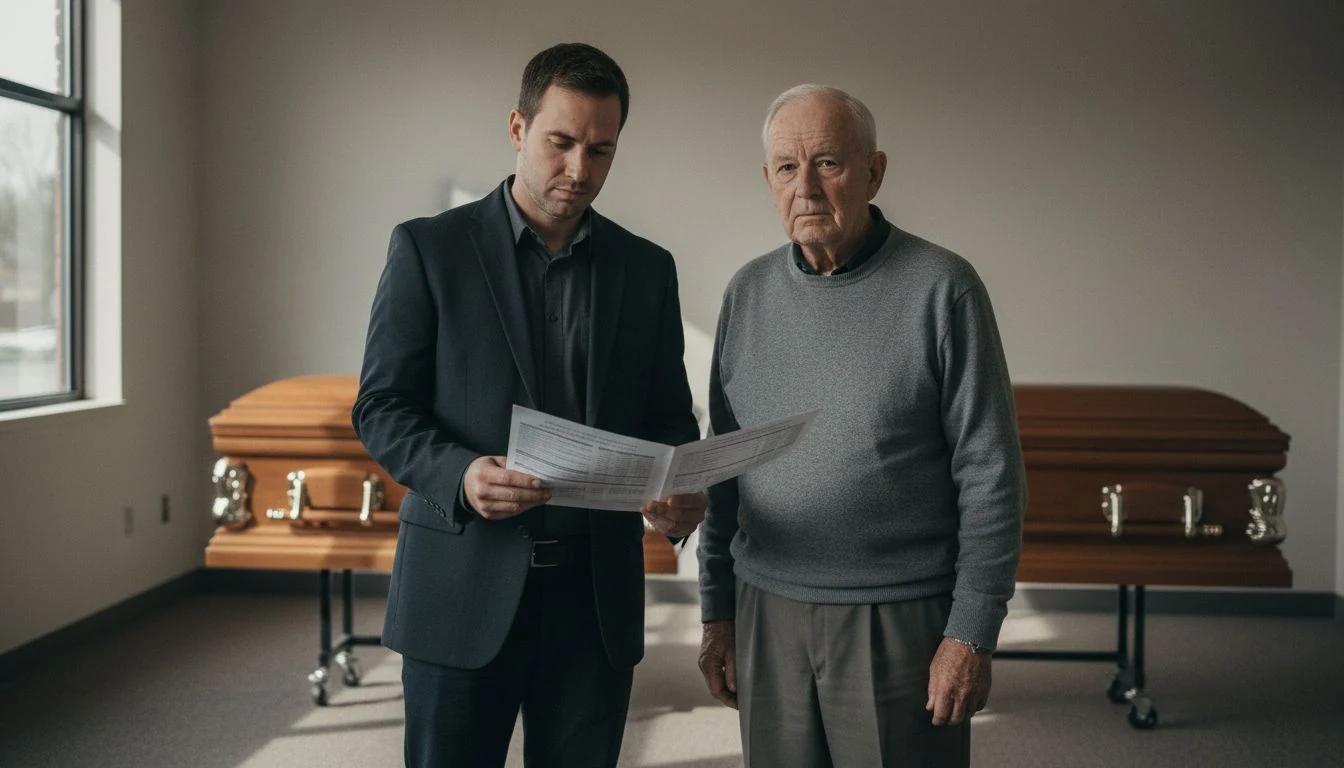
How much does a funeral cost is a question most people type into their phone at the worst possible hour, usually a day or two after a call they weren’t ready to get.
I want to be careful with this one. I’m not going to open with a tidy national average, because that number is exactly why families get blindsided at the funeral home. What I can give you is the structure of the bill, the rights you already have walking in, and the questions that move the total most.
How much does a funeral cost in 2026?
There is no single price, and any article that hands you one number without telling you what it excludes is setting you up.
Two funeral homes fifteen minutes apart can quote very different totals for the identical service. Same casket, same viewing, same hearse. The spread is real.
What I can tell you with a source: funeral prices rose 3.0% in the twelve months through August 2026, according to the Bureau of Labor Statistics consumer price index. This is not a category where last year’s estimate still holds.
Three things move the total far more than anything else:
- Burial or cremation. This is the biggest single lever, by a lot.
- Whether there’s a viewing and a ceremony at the funeral home. Facilities and staff time are priced separately, and each one is its own line.
- The cemetery. This is the one that catches families off guard.
And one structural fact that almost nobody knows going in: the funeral home’s bill and the cemetery’s bill are two different bills, from two different businesses. A quote from one tells you nothing about the other.
The price list you’re legally entitled to
I spent an afternoon reading the Federal Trade Commission’s Funeral Rule, and I came away a little angry that this isn’t common knowledge. You have more room to push back than that room makes you feel like you have.
Under the FTC Funeral Rule:
- You get a written General Price List. Funeral homes must hand you one when you visit, it lists every item and service with its price, and it’s yours to keep.
- They have to quote prices over the phone. In the FTC’s words, “Funeral directors must give you price information on the telephone if you ask for it.” You don’t have to give your name or explain yourself first.
- You see the casket price list before you see the caskets. That ordering is deliberate. Showrooms tend not to display the cheaper options.
- You can buy the casket somewhere else. The provider “cannot refuse to handle a casket or urn you bought online, at a local casket store, or somewhere else, or charge you a fee to do it.”
- Embalming is usually not required. “No state law requires routine embalming for every death.” Refrigeration is often an accepted alternative.
- You buy only what you want. Packages are a sales format, not a requirement, and you get an itemized statement of everything you selected before you leave.
That last one matters most. If someone hands you a bundle and says this is our traditional package, you are allowed to say I’d like to see the itemized list instead. It is not rude. It is the entire point of the rule.
Nobody walks into that room ready to negotiate. The price list exists so you don’t have to.
What’s actually on the funeral home’s bill
Once you have the General Price List in your hands, one scary number becomes about ten separate decisions. Most of them you’re allowed to decline.
There’s one exception, and you should know it before you go in: the basic services fee. That’s the funeral director’s overhead, planning, permits, and coordination. It’s non-declinable, it’s on every price list, and it’s usually the largest single line that isn’t the casket. Everything stacked on top of it, the viewing, the hearse, the printed programs, is a separate charge you can say yes or no to.
The casket sits in its own category. You can’t have a burial without one, but you’re not required to buy it from the funeral home, and this is where the spread between two providers gets widest.
How much does a funeral cost once the cemetery is involved?
This is the section I’d read twice.
The funeral home’s price list does not include the cemetery. Not the plot, not the labor, not the marker. A family can get a quote they feel okay about, sign it, and then find out there’s a second bill of a similar size waiting.
The cemetery side typically includes:
- The plot itself. Priced by the cemetery, and location within the cemetery changes it.
- Opening and closing the grave. Labor, billed separately from the plot. This one surprises almost everyone.
- The outer burial container or vault. Most cemeteries require one so the ground doesn’t settle. State law usually doesn’t, but the cemetery’s own policy does.
- The marker or headstone, plus a setting fee to install it.
Then there’s a third bucket the funeral home may pass through at cost: cash advance items. Flowers, the obituary notice, clergy honorarium, certified copies of the death certificate. Order more copies of that certificate than you think you need. Every bank, insurer, and county office wants its own.
Burial, cremation, and the choice that moves the number most
The country has already shifted on this. The National Funeral Directors Association put the 2025 cremation rate at 63.4% against a burial rate of 31.6%, and projects cremation reaching 82.3% by 2045.
Cremation costs less mostly because it removes the cemetery bill, the casket, and often the embalming from the equation at once. But “cremation” isn’t one product. Direct cremation, with no viewing and no ceremony at the funeral home, is the lowest-cost option most providers offer. Cremation with a full viewing and service beforehand can land close to a burial, because you’re paying for the same facilities and staff time either way.
If someone asks you what cremation costs, the useful counter-question is: with a service, or without?
One gentle tip: if you’re reading this ahead of time rather than in the middle of it, write down the three or four funeral homes nearest you and their numbers, and keep that page with your important documents. Ten minutes now saves an hour on a day you won’t have one. If you keep sinking funds, the free printable has room for this line.
How families actually pay for it
How much does a funeral cost is only half of it. How a family covers that bill in the first week is the other half, and it’s usually the more urgent one. A few things worth knowing:
- Call three funeral homes before you visit one. The phone-quote right exists precisely so you can do this from your kitchen. Ask each for the basic services fee, direct cremation, and immediate burial. Three calls, fifteen minutes.
- Ask for the itemized list, not the package. Then go down it and mark what you actually want. Bring someone with you who isn’t the closest griever if you can.
- Check Social Security. There’s a one-time lump-sum death payment of $255 for an eligible surviving spouse or child. It’s small, and you have to apply within two years. You can’t do it online, so it’s a phone call. Details are on the Social Security Administration site.
- Look at benefits that already exist. Employer life insurance or a bereavement benefit, a union, a fraternal order, or a credit union policy the person held for decades. If they served in the military, ask the funeral director about VA burial benefits; funeral homes handle those filings routinely.
- Ask the funeral home directly about payment timing. Terms vary, and it’s a normal question. Ask it before you sign, not after.
I’m not going to point you toward prepaid plans or burial insurance here. That’s a separate decision with its own tradeoffs.
How much does a funeral cost, line by line
A General Price List is built like this. The figures below are labeled examples, not national averages, and they’re here to show which lines you can refuse. The only real numbers are on the price lists from providers near you.
| Line item | Example figure | Can you decline it? |
|---|---|---|
| Basic services fee | $2,595 | No — the one non-declinable charge |
| Transfer of remains to funeral home | $395 | No, if they’re handling the body |
| Embalming | $845 | Yes, in most cases |
| Other preparation of the body | $275 | Yes |
| Facilities and staff for viewing | $475 | Yes |
| Facilities and staff for ceremony | $550 | Yes |
| Hearse | $375 | Yes |
| Service vehicle | $175 | Yes |
| Casket | $2,500 | Required for burial, but you may supply your own |
| Printed memorial package | $185 | Yes |
| Funeral home subtotal | $8,370 | — |
| Cemetery plot, opening and closing, vault, marker | Not included | Separate bill, separate business |
| Cash advances (flowers, obituary, certificates, clergy) | Not included | Often passed through at cost |
Three things that quietly raise the bill
- Accepting the package instead of the itemized list. Bundles are priced to include things you may not want, and the savings on a package are often smaller than the cost of the lines you’d have declined.
- Choosing the casket in the showroom before reading the casket price list. The FTC gave you the right to see prices first for a reason. Displays skew toward the middle and upper end.
- Treating the funeral home quote as the total. If nobody has said the words plot, opening and closing, vault, or marker to you yet, you have not seen the whole number.
The sinking fund nobody wants to name
I’ve built sinking funds for car repairs, for vet bills, for Christmas, for the annual insurance premium that always seems to land in a bad month. I have written out dozens of categories over the years. Not one of them was this.
There’s a reason for that, and it isn’t a budgeting reason. Naming the category means picturing the day. It stays off the list, and then it arrives anyway, usually alongside time off work and travel and a hundred small costs nobody itemizes.
If you’re in a position to plan rather than react, a small monthly amount into a separate, boring, clearly-labeled fund does more than any product I could point you at. Twenty-five dollars a month is three hundred a year. It won’t cover everything. It changes what your options look like on day one, which is the part that matters.
If you want the mechanics, I’ve written them up in how to set up sinking funds and the longer sinking fund categories list. If you don’t have a general cushion yet, start with building an emergency fund first, because that one covers more ground. You can find the rest of the saving money posts if you want to go further, and there’s context on household saving patterns in our budgeting statistics roundup.
And if you’re reading this because it already happened: you are allowed to ask for the itemized list. You are allowed to decline things. You are allowed to take the price list home and call someone. None of that means you loved them less.
Frequently Asked Questions
How much does a funeral cost with cremation?
Less than burial in almost every case, but the range is wide because cremation isn’t one product. Direct cremation, with no viewing or ceremony, is the lowest-cost option most providers offer. Cremation with a full service can approach burial pricing, since you’re paying for the same facilities and staff hours. Ask for both prices separately.
Does the funeral home price include the cemetery plot?
No. The funeral home and the cemetery are separate businesses with separate bills. The plot, opening and closing the grave, the outer burial container or vault, and the marker are all billed by the cemetery. This is the most common reason a family’s final total comes in far above the quote they agreed to.
Can I get funeral prices over the phone?
Yes. The FTC Funeral Rule requires funeral directors to give price information over the phone if you ask, and you don’t have to give your name or personal details first. Calling three providers before you visit any of them is the single most useful thing you can do, and it takes about fifteen minutes.
Is embalming required by law?
Generally no. The FTC states that no state law requires routine embalming for every death, and refrigeration is often an accepted alternative. It may be required for certain public viewings or transport, so ask the funeral director to explain why it’s being recommended in your case.
Does Social Security help pay for a funeral?
Only a little. Social Security pays a one-time lump-sum death payment of $255 to an eligible surviving spouse or, in some cases, a child. You must apply within two years of the death and you can’t apply online, so it requires a phone call. Treat it as a small reimbursement rather than a funding source.
Grab my free Monthly Budget Template
The same cozy spreadsheet I use to track every dollar — sinking funds, bills, and savings, all in one place. Join the newsletter and I’ll send it straight to your inbox.
No spam, ever. Unsubscribe anytime. — Nora
Keep reading — more on Saving Money