
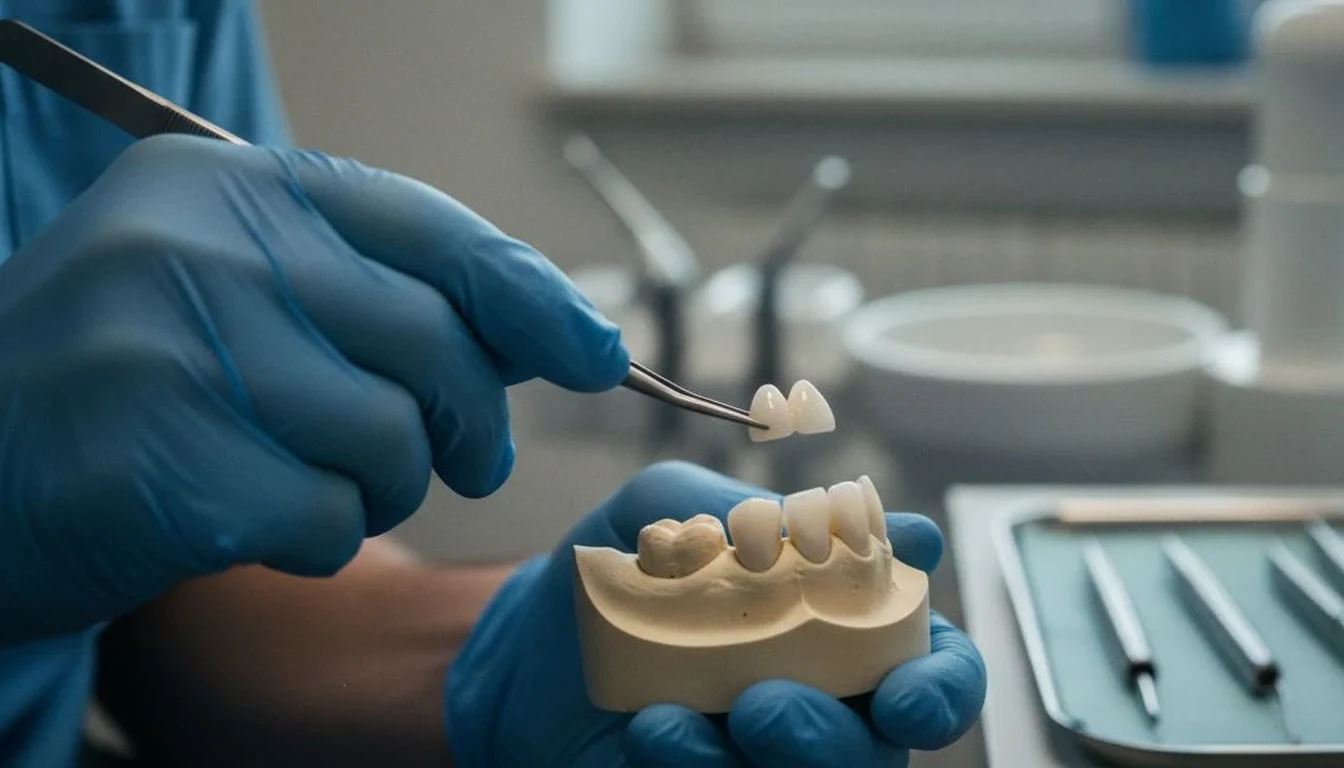
How much does a crown cost? A porcelain dental crown averages about $1,560 in the U.S., and most fees land between $1,015 and $2,670, according to Pearl’s summary of American Dental Association fee survey data. Your share depends on your insurance, and most PPO plans pay around half after the deductible, up to the annual maximum. That last clause is what makes November and December a very good time to read your plan.
Crowns have a way of showing up as a surprise. You go in for a cracked filling, and you leave with a four-figure treatment plan and a temporary tooth. So here’s what I’d want in front of me at that moment: what it costs by state, what’s usually left out of the quote, the insurance rules that can get a claim denied, and the math on your year-end benefits. I’m not a dentist. I’m the person who paid off about $14k of card debt and got very serious about never letting a predictable bill catch me off guard again.
How much does a crown cost in your state?
Here’s what Pearl’s dental crown cost guide shows for a porcelain crown as of its May 2026 update. Pearl says the data is based on ADA fee survey numbers, plus regional fee schedules and public insurance reimbursement data:
- National average: $1,560.
- Typical range: $1,015 to $2,670.
- Highest-cost areas: Hawaii ($1,975), New York ($1,905), and D.C. and Alaska ($1,825 each).
- Lowest-cost states: Oklahoma ($1,355), Louisiana ($1,375), and Ohio, Mississippi and Arkansas ($1,400 each).
Those are averages, not a quote, and Pearl says so too. But a $620 gap between Hawaii and Oklahoma tells you that geography matters. Prices vary by office as well, so a second quote is worth your time if the first number takes your breath away and your tooth isn’t an emergency.
What about the material? Zirconia, porcelain and gold
I went looking for a reliable national price list by material, and I didn’t find one I trust. The pages ranking for this mostly come from clinics and marketing sites, and their numbers disagree with each other. So I’m not going to hand you a neat chart I can’t stand behind.
Here’s what I can tell you. Pearl names all-ceramic, porcelain-fused-to-metal (PFM), zirconia and gold as the common options. It describes zirconia as the strongest and all-ceramic as the most natural-looking. And it says insurers generally reimburse porcelain, zirconia and PFM crowns at the same allowed fee.
That last detail is the budgeting takeaway. If your office charges more for one material, the difference may come straight out of your pocket. Ask for each option’s price in writing, and ask your dentist which ones are appropriate for that tooth. That part is a clinical call, and I’d leave it to them.
Ask for the quote to list every line, including the build-up. A crown price with a blank spot in it isn’t really a price.
What’s in the quote, and what usually isn’t
Pearl’s checklist is the most useful thing I found. Usually included in the crown price:
- Local anesthesia and tooth preparation.
- The impression or digital scan.
- The temporary crown and lab fee.
- The final fitting and polish.
Often billed separately:
- Build-up (post and core). Extra material that supports the crown if there isn’t much tooth left.
- A root canal, if you need one. My post on root canal costs runs through that pairing, and the two together can pass $2,600 before insurance.
- Sedation beyond local anesthesia.
- Crown lengthening, if your dentist needs it before placing the crown.
Most crowns take two visits, with a temporary in between, and some offices make same-day crowns. If you’re paying with cash or a card, it helps to know whether the bill lands all at once or across two appointments. Ask, because it decides which paycheck has to carry it. And if you’ve got two offices quoting you, make sure they’re pricing the same lines, or the cheaper one might only look cheaper.
How much does a crown cost with insurance?
Pearl says most PPO plans cover crowns at 50% after the deductible, up to the annual maximum. So on a $1,560 crown with a $50 deductible, the plan’s share is $755 and yours is $805, assuming your maximum has room. If this is the kind of insurance you have, here are the rules I’d check, all from Pearl’s guide:
- Waiting periods. New members can wait 6 to 12 months for major benefits. If you just signed up, this could matter more than the percentage.
- Medical necessity. Coverage depends on a reason like a root canal, a large filling or a fracture. Cosmetic crowns may not be covered.
- The “can a filling fix it?” rule. Plans may require proof that a filling won’t work, and a claim can be denied otherwise.
- Replacement limits. A new crown within five years of the old one is typically denied.
- Pre-authorization. Some carriers require it for back-tooth crowns. Have the office submit it before the appointment so you know your number first.
I’d ask the office and the insurer for the same thing: a pre-treatment estimate, with your remaining maximum on it. And if you’re picking dental coverage during open enrollment, read the waiting period line before you get excited about a low premium.
How much does a crown cost without insurance?
Without a plan, you pay the office’s full fee, so budget from the state averages above plus any build-up. That’s a heavy number for a lot of paychecks, and if it has made you put off an appointment, you’re not doing anything shameful. Treat it as a math problem with a few options:
- Use pre-tax money. Pearl says FSA and HSA funds can go toward your share, and IRS Publication 502 treats payments for preventing and alleviating dental disease as medical expenses.
- Ask about an in-office payment plan. Find out whether there’s interest and what happens if you miss a payment.
- Ask about a cash-pay price. It costs nothing to ask whether the office discounts for paying in full.
- Look at a dental school clinic. Fees are often lower, with supervised students and longer appointments.
I’d be careful with medical credit cards that advertise “no interest if paid in full.” If there’s a balance on the deadline, deferred interest can land on the original amount. My guide to negotiating medical bills covers asking for a lower price or a longer plan first.
Cozy tip: Crowns last, so budget for them like the long-term purchase they are. Pearl puts a crown’s expected life at 10 to 15 years, which makes a $1,560 crown about $104 to $156 a year. A small “teeth” line in your sinking funds makes that very doable, and our free budget printable has a page ready for it.
The Dec. 31 math: what your leftover maximum can do
On many plans, the annual maximum resets when your new plan year starts, often January 1, and unused money generally doesn’t help you later. The example below uses Pearl’s national average and a made-up plan: 50% coverage, a $50 deductible that hasn’t been met, and three different amounts left on the maximum.
| Maximum left this year | Plan’s calculated share | Plan actually pays | You pay on a $1,560 crown |
|---|---|---|---|
| $1,500 (untouched) | $755 | $755 | $805 |
| $800 | $755 | $755 | $805 |
| $300 | $755 | $300 | $1,260 |
| $0 | $755 | $0 | $1,560 |
See how flat the first two rows are? If you have enough room left, there’s nothing to gain from waiting and you may lose unused benefits at year-end. If the maximum is nearly gone, the opposite can be true, and January may pay more. Timing is a conversation with your dentist, since a tooth that needs work shouldn’t wait on my spreadsheet. But knowing which row you’re in takes one phone call.
Here’s what I’d ask on that call:
- How much of my annual maximum is left, in dollars?
- When does my plan year end?
- Have I met my deductible, and what’s my coverage percentage for crowns?
If you’re booking before the holidays, call this week. December dental calendars can fill up, and many crowns take two visits.
Common mistakes when budgeting for a crown
- Assuming the quote covers everything. A build-up, sedation or crown lengthening may be billed separately.
- Assuming a new plan works on day one. A 6-to-12-month waiting period for major work can leave the whole bill with you.
- Trusting the 50% without checking the maximum. Fillings and cleanings earlier in the year may have used part of the same pool.
Your regular visits can eat into that pool too, so here’s what a dental cleaning costs, and if your family is also weighing orthodontics, here’s how much braces cost. For broader context, I keep a list of budgeting statistics, and you’ll find more like this in our budgeting section.
Frequently Asked Questions
How much does a dental crown cost without insurance?
Pearl’s summary of ADA fee survey data puts a porcelain crown at about $1,560 on average, with a typical range of $1,015 to $2,670. A build-up, root canal or sedation may be billed separately, so ask for a full written quote.
How much does insurance pay for a crown?
Pearl says most PPO plans cover crowns at 50% after the deductible, up to the annual maximum. Coverage usually depends on medical necessity, and new members may wait 6 to 12 months for major benefits. A pre-treatment estimate gives you the real number.
Is a zirconia crown more expensive than porcelain?
It can be, but I couldn’t find a trustworthy national price list by material. Pearl says insurers generally reimburse porcelain, zirconia and PFM crowns at the same allowed fee, so any price difference may be yours to cover. Ask the office to quote each option.
How long does a dental crown last?
Pearl lists an expected lifespan of 10 to 15 years. At the national average, that works out to roughly $104 to $156 a year. Insurance often won’t pay for a replacement within five years of the original.
Can I use my HSA or FSA for a crown?
Pearl says FSA and HSA money can go toward your share, and IRS Publication 502 treats payments to prevent and alleviate dental disease as medical expenses. Crowns placed only for looks may be treated differently, so keep your records and check with your plan.
Grab my free Monthly Budget Template
The same cozy spreadsheet I use to track every dollar — sinking funds, bills, and savings, all in one place. Join the newsletter and I’ll send it straight to your inbox.
No spam, ever. Unsubscribe anytime. — Nora
Keep reading — more on Budgeting Methods