
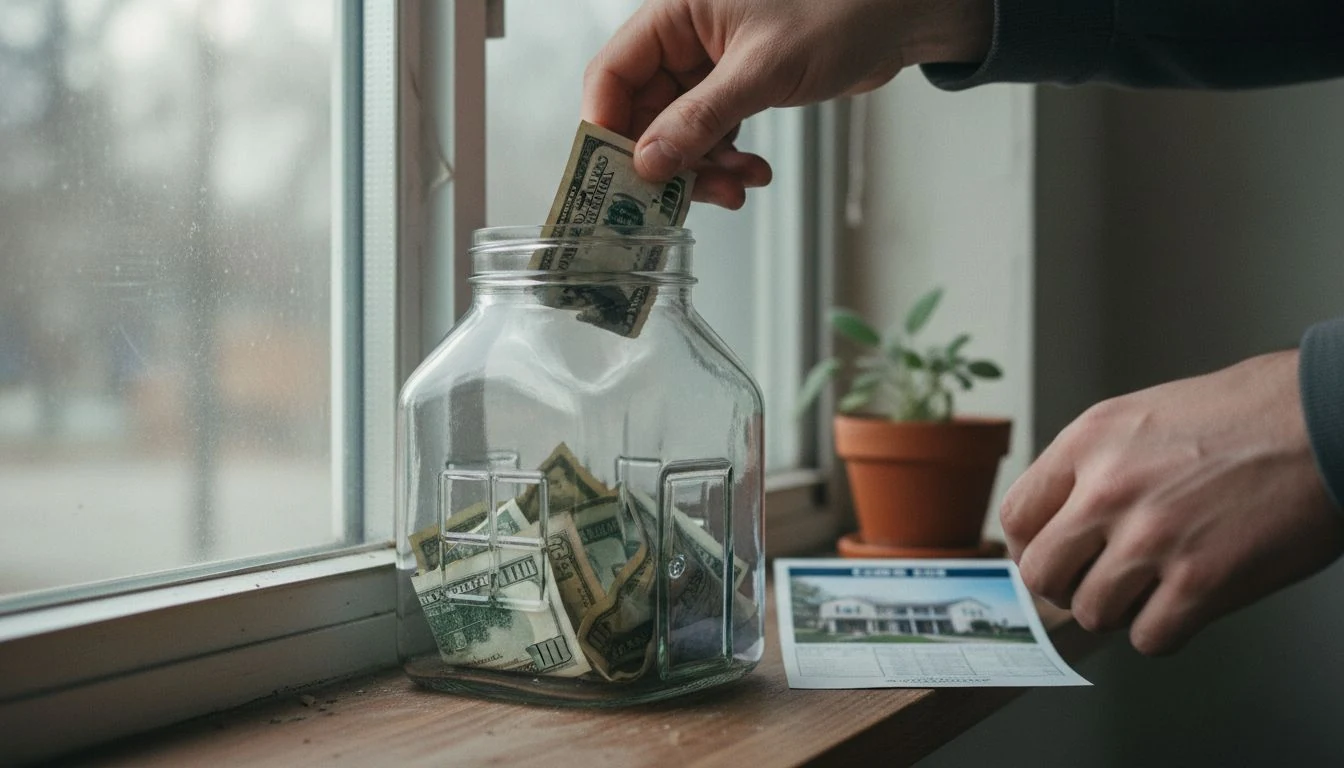
The average down payment on a house for a first-time buyer is 10% of the price, and for everyone else it’s closer to a quarter. I read those two numbers on a Sunday morning in my rental kitchen and felt two very different things in about four seconds.
The 10% made me feel behind. Then I looked at who the 23% people were, and I felt a lot better. I’ve been putting $600 a month toward a house for about a year and a half, so I care about these numbers more than is probably healthy. Below are the real figures, what they look like in dollars, why the gap between first-time and repeat buyers is so big, and where buyers find the money.
The average down payment on a house, by buyer type
The best source here is the National Association of Realtors’ yearly Profile of Home Buyers and Sellers. The latest edition, released November 4, 2025, covers purchases from July 2024 to June 2025. Here’s what it found, per NAR’s release:
- First-time buyers: 10% median down payment. That’s the highest for first-timers since 1989.
- Repeat buyers: 23%. The highest for that group since 2003.
- All buyers combined: about 19%. This blended number is the one headlines love, and it’s the least useful for a first-time buyer.
Those are medians, so half of buyers put down less. Plenty of people buy with 3% or 3.5% down. The median just tells you where the middle of the crowd stands.
If you’re comparing your savings to the 19% headline, you’re comparing yourself to someone who probably just sold a house.
What those percentages look like in dollars
Percentages feel abstract until you put a price next to them. NAR’s median existing-home price was $429,100 in August 2026, up 1.6% from a year earlier. Using that price as the example:
| Benchmark (at a $429,100 example price) | Share down | Cash needed | Who this usually is |
|---|---|---|---|
| Conventional loan minimum | 3% | $12,873 | First-time buyers using low-down-payment programs |
| FHA loan minimum | 3.5% | $15,019 | Buyers with credit scores of 580 or higher |
| Median first-time buyer | 10% | $42,910 | The middle of the first-time crowd |
| Median of all buyers | 19% | $81,529 | A blend skewed by repeat buyers |
| The classic “rule” | 20% | $85,820 | The number that skips PMI on a conventional loan |
| Median repeat buyer | 23% | $98,693 | Owners rolling equity from a sale |
Look at the jump from the third row to the fourth. That’s almost $39,000 between “typical first-time buyer” and the average everyone quotes. When I first saw it laid out like this I laughed out loud, a little bitterly, because I had been aiming at the wrong row for months.
One more caveat about that table: the national median price hides huge local swings. The average down payment on a house in a small Midwestern town and in a coastal metro can differ by more than the price of a new car, even at the same percentage. Before I set my own target I pulled the median sale price for the three zip codes I’d actually live in. Two of them were well below the national figure, and one was painfully above it. I picked the middle one and built every number from there, which made the goal feel like mine instead of a headline’s.
Why repeat buyers put down so much more
Most repeat buyers aren’t saving a 23% down payment from their paychecks. They’re selling a home they bought years ago and moving the equity into the next one. Someone who bought in 2016 and sold this year might walk away with a six-figure check before they write a single offer.
They’re also older. NAR puts the median age of a repeat buyer at 62, and 30% of repeat buyers paid all cash. First-time buyers had a median age of 40, an all-time high, and made up just 21% of buyers, a record low.
I find that comforting in a strange way. If you’re 29 or 34 and your savings look nothing like the national average down payment, the average was never built from people in your situation.
Where buyers get the down payment money
According to NAR, first-time buyers pulled their down payment from these places (many used more than one):
- Personal savings: 59%. The slow, boring way, and still the most common.
- Financial assets such as a 401(k), stocks or crypto: 26%. Selling investments or borrowing from a retirement plan.
- Gifts or loans from family and friends: 22%. More than one in five.
That last one stung a little. Nobody is handing me $20,000, and that’s fine. But it does mean some of the people buying “on their own” at 31 had help that never shows up in the Instagram post. Comparing yourself to them is like comparing your grocery bill to a friend whose parents still pay for her phone.
On the 401(k) route, I’d be careful. Pulling money early can come with taxes and penalties, and a loan from your plan has to be repaid. I’m not touching mine. If you’re weighing it, talk to your plan administrator first and read the fine print twice.
How long it takes to save the average down payment on a house
Longer than anyone wants. In the example above, the median first-time down payment is $42,910. At $1,000 a month, that’s about 43 months, or three and a half years, before interest. At my $600 a month it’s closer to six years, which is exactly why I’m not aiming for 10%.
I already wrote the full system I use in my plan for saving for a house, including the account I keep it in and the closing-cost surprise that pushed my finish line out by $11,000. I won’t repeat it here. The short version: pick a real price in your area, pick a percentage you can live with, add closing costs, and divide by the months you’re willing to keep renting.
Your down payment also changes what you’ll pay every month afterward. A smaller down payment means a bigger loan and usually PMI. I broke that down in my post on the average mortgage payment, and it’s worth reading both together before you pick your number.
Down payment minimums by loan type
You don’t need 20% for most loans. The rough minimums look like this:
- Conventional loans can go as low as 3% down for some first-time buyer programs, with PMI until you reach 20% equity.
- FHA loans ask for 3.5% down with a credit score of 580 or higher, or 10% down with a score between 500 and 579.
- VA loans often need 0% down for eligible service members and veterans.
- USDA loans often need 0% down for eligible homes in qualifying rural and suburban areas.
Many states and cities also run down payment assistance programs for first-time buyers, and the Consumer Financial Protection Bureau’s homebuying guide is a good free place to start learning the steps without a sales pitch. I found two programs in my county I’d never heard of. One of them would cut my timeline by about eight months if I qualify.
Picking a down payment that fits your life
I used to think the bigger the down payment, the better. Now I think the right down payment is the one that still leaves you an emergency fund the day you get the keys. A house with an empty savings account is a stressful house.
There’s a trade-off hiding in here, too. Waiting to match the average down payment on a house can mean two or three extra years of rent, and rent doesn’t build equity. Buying sooner with less down means PMI and a higher payment, but you start owning earlier. I don’t think one answer fits everyone. I ran both versions for my own numbers and wrote down which one let me sleep.
Here’s how I’m thinking about my own number, for what it’s worth:
- I want at least 5% down, so the monthly payment and PMI don’t swallow my budget.
- I’m keeping three months of expenses separate, untouched by the house fund.
- I’m setting aside closing costs as their own line, because I got burned on that once already.
If you want to see how your savings compare to people your age, my no-shame look at how much you should have saved by 30 helps put it in context, and my roundup of budgeting statistics shows how other households split their money. More saving ideas live in the saving money section.
Cozy tip: open a separate savings account and name it after your goal, like “Front Door 2029.” It sounds silly, and it kept me from raiding mine twice this year. Start with whatever amount doesn’t make you flinch, even $50, and grab our free printable savings tracker to color in a little box every time you add to it.
Common down payment mistakes
- Measuring yourself against the 19% headline. It mixes in repeat buyers with home equity. First-time buyers put down a median 10%.
- Forgetting closing costs. They’re paid on top of the down payment and can add thousands to the cash you need on closing day.
- Emptying your emergency fund to hit a bigger percentage. A few extra points down won’t help if the water heater dies in month two and you have nothing left.
Frequently Asked Questions
What is the average down payment on a house?
According to NAR’s 2025 Profile of Home Buyers and Sellers, the median down payment was 10% for first-time buyers and 23% for repeat buyers, about 19% across all buyers. On a $429,100 home, 10% is about $42,910.
Do you really need 20% down to buy a house?
No. Many conventional loans allow 3% down, FHA loans allow 3.5% with a 580 credit score, and VA and USDA loans can allow 0% down for eligible buyers. Putting down less than 20% on a conventional loan usually means paying PMI.
How much is a down payment on a $300,000 house?
At 3% it’s $9,000, at 3.5% it’s $10,500, at 10% it’s $30,000 and at 20% it’s $60,000. Closing costs are extra.
Can I use gift money for a down payment?
Yes, most loan types allow gift money from family, usually with a signed gift letter. NAR found 22% of first-time buyers used gifts or loans from family and friends.
Is it better to put more money down or keep savings?
It depends on your situation, but keeping an emergency fund after closing matters. A larger down payment lowers your monthly payment, while cash reserves protect you from surprise repairs.
Grab my free Monthly Budget Template
The same cozy spreadsheet I use to track every dollar — sinking funds, bills, and savings, all in one place. Join the newsletter and I’ll send it straight to your inbox.
No spam, ever. Unsubscribe anytime. — Nora
Keep reading — more on Saving Money