
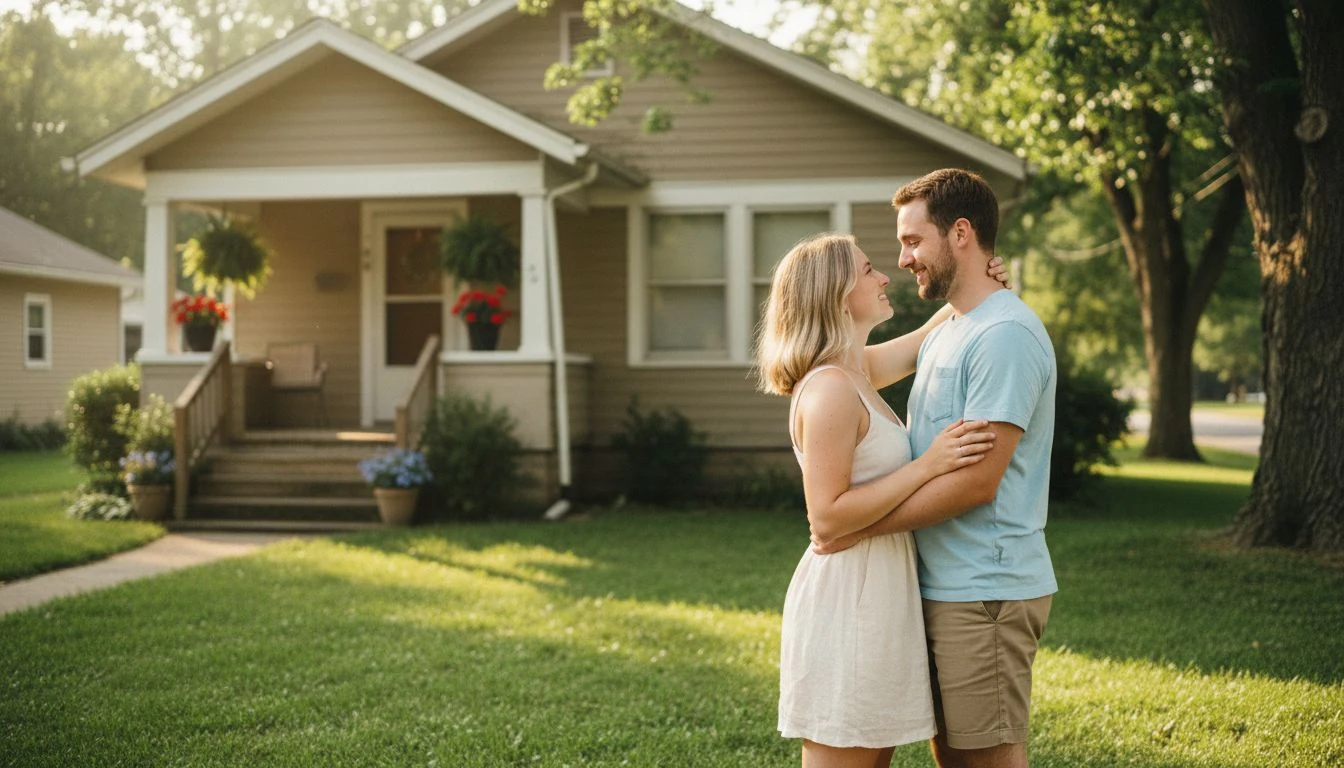
The best way to save for a house is the one you can still be doing in month eighteen, after the novelty has worn off and your friend just bought a condo.
I’m fourteen months into saving for a down payment, and I’m not finished. Still moving money every other Friday, still adjusting the plan. I’ve already made one expensive mistake that I’d like you to skip. This is the best way to save for a house that I’ve found so far: the system I use, the number I’m saving toward, and where that money sits while it waits.
The best way to save for a house starts with one honest number
Most people start by picking a monthly amount. Two hundred dollars, maybe five hundred, whatever feels survivable. Then they save into a vague fog labeled “house” and wonder why it never feels closer.
Backwards. You need the target first, because the target is what tells you the monthly number. And your target is not the down payment, which is the part that cost me five months.
It’s the down payment plus closing costs plus the money you’ll need the week after you move in. I saved toward the down payment alone until last spring, when I finally sat down with a real cost breakdown and realized I was roughly $11,000 short of the actual finish line. Not behind on my savings. Behind on my math.
I wasn’t saving too slowly. I was saving toward a number that didn’t exist.
Kill the 20% rule before it costs you four years
Somewhere along the way, 20% down became gospel. It’s the single most discouraging number in home buying, and for a lot of buyers it’s optional.
Conventional loans exist with 3% down. FHA loans sit at 3.5% for buyers who qualify. Twenty percent isn’t a requirement, it’s a threshold with one specific benefit: below it, a conventional loan usually comes with private mortgage insurance.
And PMI is worth understanding properly rather than fearing. According to the Consumer Financial Protection Bureau’s explainer on private mortgage insurance, PMI is insurance you may be required to buy on a conventional loan when you put down less than 20%, and it protects the lender, not you. That’s a real cost. It is not a reason to spend an extra four years renting while you chase 20%.
Run both versions and let the numbers argue. Sometimes waiting for 20% wins. Often it doesn’t, because rent doesn’t pause while you save. The best way to save for a house is whichever version actually gets you into one.
How to find your actual target number
Your target has three pieces.
- The down payment. Pick a percentage you’d realistically use, not the one you wish you could. I’m building toward 5%.
- Closing costs. These are the fees paid at closing, and they’re commonly cited in the 2% to 5% range of the purchase price. The CFPB’s home buying guide walks through what’s in them and offers a closing checklist, plus referrals to HUD-certified housing counselors if you want a human to read your paperwork.
- The move-in reserve. The unglamorous one everybody forgets. A fridge that doesn’t come with the place, a locksmith, a mattress that fits the new room, the first repair nobody disclosed. I hold $3,000 for this and I’ve heard from enough people that I’d never go lower.
Add those three. That’s your number. Write it somewhere you’ll see it, because a vague goal gets raided and a specific one doesn’t.
The best way to save for a house down payment is a boring account
Where to keep the money is the question I get asked most, and the answer depends on your timeline.
Money you need in under three years does not belong in the stock market. I know how that sounds in a year when everyone’s portfolio is up. But a down payment has a date attached, and a 20% dip six weeks before closing isn’t a paper loss you can wait out. It’s a house you don’t buy.
A high-yield savings account handles anything inside three years. I keep mine at a different bank from my checking, so moving it takes more than one thumb-tap. If you’re picking one, I broke down what I compare in my guide to the best high-yield savings accounts.
If your timeline is longer and firmer, a CD can make sense for a chunk of it, as long as the maturity date lands before you’d need the cash. I compared the tradeoffs in high-yield CDs versus HYSAs. Personally I keep it all liquid, because my timeline has already moved twice.
Building the monthly number backward from a date
The process, in order:
- Set your target. Down payment plus closing costs plus move-in reserve, from the section above.
- Pick a month, not a year. “Sometime in 2029” is not a deadline. “March 2029” is.
- Divide. Target divided by months remaining. This number will probably annoy you.
- Subtract what’s already earmarked. If you have $4,000 saved, take it off the top before dividing.
- Automate it the day you get paid. Not the day before rent. The day the money lands, before you’ve seen it sitting there.
- Recheck every quarter. Rates move, prices move, your income moves. Mine has changed three times.
If the monthly number comes out impossible, you have three real levers and none of them are “try harder”: move the date, lower the target percentage, or find more income. Guilt is not a lever.
Keep your emergency fund out of this
This is the mistake I see wreck the most house funds, and it happens quietly.
You start saving for the down payment, your car needs $900 of work, and the only real money in your life is the house money. So you take it. Then you take it again in November. By spring you’re back where you started and you’ve decided you’re just bad at saving, which isn’t true. You just built one fund doing two jobs.
Fund the emergency money first, even if it delays the house. If you’re starting from nothing there, my walkthrough on building an emergency fund from $0 covers the starter version, and I keep mine in a separate high-yield account for exactly this reason.
The house fund should be boring. Untouched, single-purpose, slightly inconvenient to reach.
Cozy tip: Name the account. Not “Savings 2” but “March 2029 House.” Most banks let you rename an account in about ninety seconds, and it’s much harder to pull $600 out of March 2029 House than out of Savings 2. If you want the whole thing on paper first, the free monthly budget printable has a sinking fund page you can use for this.
What the same house costs at four different down payments
This is the table I wish someone had shown me in month one. Same house, same savings rate, four choices. Watch the last column, because that’s where the decade goes.
| Down payment | Cash for down payment | Closing costs | Move-in reserve | Total cash needed | Months at $600/mo |
|---|---|---|---|---|---|
| 3% | $9,600 | $8,000 | $3,000 | $20,600 | ~34 months |
| 5% | $16,000 | $8,000 | $3,000 | $27,000 | ~45 months |
| 10% | $32,000 | $8,000 | $3,000 | $43,000 | ~72 months |
| 20% | $64,000 | $8,000 | $3,000 | $75,000 | ~125 months |
Two things jump out of that table. Closing costs and the reserve are a fixed $11,000 no matter which row you pick, which is why ignoring them breaks your timeline at every level. And the distance between the top row and the bottom row is not a little patience. It’s roughly seven and a half extra years of rent.
Three mistakes that quietly cost the most
- Saving toward the down payment only. This was mine. It cost me five months of building toward a finish line that was about $11,000 further out than I thought.
- Parking a two-year goal in the market. The upside is real and so is the downside, and a down payment has a date. Short timeline money goes somewhere boring.
- Letting one account do two jobs. When the house fund is also the emergency fund, the car repair always wins and the house always loses.
Frequently Asked Questions
What is the best way to save for a house on a low income?
Same structure, different levers. Set the target using the lowest down payment percentage you’d qualify for, stretch the date rather than the monthly amount, and automate a number small enough that you never have to cancel it. Consistency at $150 a month beats $600 for two months and then nothing. My guide on saving on a low income has the category-by-category version.
How much should I save for a down payment?
Take your realistic down payment percentage of your target price, add 2% to 5% of the price for closing costs, then add a move-in reserve of a couple thousand dollars. In the $320,000 example above, a 5% buyer needs about $27,000 all in, not the $16,000 the down payment alone suggests.
Do I really need 20% down to buy a house?
Usually no. Conventional loans go as low as 3% down and FHA loans start at 3.5% for eligible buyers. Putting down less than 20% on a conventional loan generally means paying private mortgage insurance, which is a genuine monthly cost, but it is not the same thing as being unable to buy.
Should I pay off debt or save for a house first?
High-interest debt usually wins, because a 24% credit card is costing you more than a savings account is paying you. The exception is your emergency fund, which comes before both. I’d get a starter emergency fund in place, clear the high-interest balances, then put the freed-up payment straight into the house fund.
What’s the fastest way to save for a house without hating my life?
Lower the target instead of raising the sacrifice. Dropping from 20% down to 5% on the example above cuts the timeline from about 125 months to about 45, which no amount of skipped coffee will match. After that, automate on payday and put windfalls like tax refunds or bonuses straight in.
Where I am right now: still saving, timeline moved twice, on track for a 5% down payment and at peace with paying PMI for a few years. That’s the version nobody posts about. If you want the numbers behind how Americans actually save and spend, I keep a running page of budgeting statistics with sources, and there’s more in saving money if you’re building a goal fund of your own. The sinking fund setup is the mechanism I use for all of it, and if you want practice hitting a big number on a short timeline first, saving $5,000 in six months is a good trial run.
Grab my free Monthly Budget Template
The same cozy spreadsheet I use to track every dollar — sinking funds, bills, and savings, all in one place. Join the newsletter and I’ll send it straight to your inbox.
No spam, ever. Unsubscribe anytime. — Nora
Keep reading — more on Saving Money