
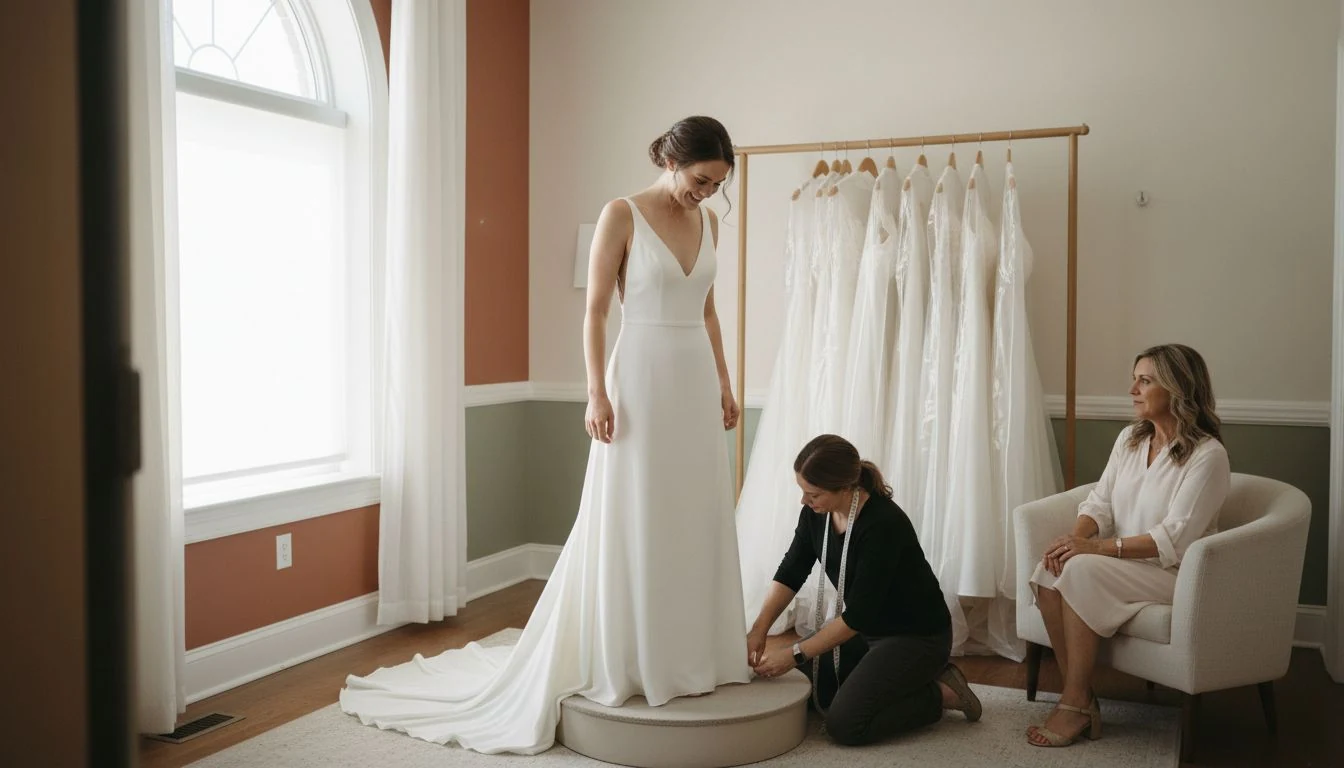
A high yield savings account for wedding money is the boring answer to a question that feels anything but boring: where do you park thousands of dollars for a date that is eighteen months away and terrifying?
I have not planned a wedding. What I have done is run the same savings system for every big dated goal I’ve had since I paid off $14,200 in credit card debt, and the wedding version is the one readers ask me about more than any other. This post skips the vendor advice and stays on the money mechanics: what number you’re saving toward, how much leaves your paycheck each month, and where it sits so you don’t spend it on a Tuesday.
Why a high yield savings account for wedding money beats your checking account
Checking accounts are designed to be spent from. That’s their whole job. Money sitting in one next to your rent and your grocery spending starts to feel like a cushion after about six weeks.
I learned this the expensive way with a much smaller goal. I kept $2,800 of car-repair savings in checking for four months because moving it felt like a chore. By the time the repair came, I had $1,900. Nothing dramatic happened. I just made a hundred small decisions differently because the balance looked healthy.
A separate high-yield account fixes two things at once. The money is one transfer away instead of zero, which is enough friction to stop the drift. And it earns something while it waits, which on a wedding-sized balance is not nothing.
- The balance is legible. One account, one goal, one number you can read in three seconds without doing subtraction.
- Interest compounds on a big balance. A fund averaging $15,000 across 18 months earns real money at 4% and roughly nothing at 0.01%.
- It’s insured. Deposits at a bank in the program are protected up to the standard limit, which matters when your balance climbs past what you’ve ever held. The FDIC explains the coverage rules in plain language, and it’s worth five minutes before you open anything.
- It’s still liquid. No lockup, no penalty. When the caterer needs the balance, you transfer it.
The deposit schedule is your real deadline
Almost every wedding savings guide gets this part wrong, and it’s why people who did the math still end up putting a deposit on a credit card.
Your wedding total is not due on your wedding day. It leaves in pieces, and the first pieces leave early. The venue wants a deposit at booking. So does the photographer. Meanwhile the caterer, which is usually the biggest single line, doesn’t bill the balance until the final headcount is in.
Take a $28,000 budget, divide it by 14 months, set up a $2,000 transfer, and you will be short in month four. You didn’t overspend. You planned against the wrong deadline.
The wedding date is when the party happens. It is not when the money is due.
The fix takes about twenty minutes. Write down every vendor you plan to book, when the deposit is due, and how much. Then check the running total against your savings balance at each of those dates, not just the final one. If there’s a gap in month four, front-load the first four months and the later ones get easier.
How much to put in a high yield savings account for wedding costs each month
Once you have the deposit timeline, the monthly number is arithmetic. Do it in this order.
- Set the target. Your realistic total, not your dream total. Add 10% on top for the line items nobody budgets: alterations, tips, the marriage license, the day-of stuff you’ll buy in the last two weeks.
- Subtract what already exists. Money already saved, plus any contribution from family that is actually confirmed. Verbal maybes are not a line item.
- Count your months honestly. Count to the month before your first big deposit, not to the wedding. That’s your real runway.
- Divide, then check it against your budget. If the number is more than you can move without touching rent or your emergency fund, the date moves or the total moves. Those are the two levers. There isn’t a third.
- Automate it for the day after payday. Not the 1st. The day after money lands, so it leaves before you’ve mentally spent it.
In a $28,000 example with $4,000 already saved and 14 months of runway, that’s $1,715 a month. Split between two people, $858 each. Seeing it as a per-person, per-paycheck number is what makes it feel possible instead of abstract.
If that number makes you flinch, that’s useful information and not a failure. It usually means the date needs another six months. I’d rather you learn that in month one than in month nine with a credit card out.
Cozy tip: Name the account. Not “Savings 2,” but something like “October Wedding.” I renamed mine years ago and it changed how often I transferred money out. If you want the monthly math laid out somewhere other than your notes app, my free printable budget template has a goals page you can use for this.
Where wedding money should not live
Four places I’d push back on, and why.
- Your emergency fund. These are different jobs. Your emergency fund covers a job loss; the wedding fund covers a known bill. Blend them and one bad month costs you both. I keep mine completely separate, and I wrote about why the emergency fund gets its own account if you want the longer version.
- The stock market. For money you need on a fixed date inside three years, market risk is not a trade you want. A 15% dip six weeks before your final payment is not a hypothetical.
- A CD, if your date is inside a year. The rate can be slightly better, but the money is locked and your deposit schedule isn’t. If your date is genuinely two-plus years out, a CD ladder can work for the portion you won’t touch early. I compared CDs against high-yield savings here.
- A joint checking account you both spend from. Same drift problem as above, doubled, because now two people are making small decisions against one balance.
How to choose a high yield savings account for wedding savings
I’m not going to rank banks in this post, because rates move and this is money you can’t afford to be casual with. The comparison that matters is short: the rate, whether it’s introductory, the minimum balance, transfer speed to your checking, and deposit insurance.
Transfer speed is the one people skip and then regret. If a vendor needs a wire on Thursday and your bank takes three business days, you have a problem that a 0.3% better rate does not solve. Check it before you fund the account, not after.
If you want my full comparison of what to look for, it’s in my guide to choosing a high-yield savings account, and the rest of the high-yield savings category covers the account types.
Two people, one wedding fund
The setup I’d recommend: one shared high-yield account that both of you transfer into, and both of you keep your own checking. Contributions can be equal dollars or equal percentages of income. Equal percentages is fairer when incomes are different, and it prevents the quiet resentment that builds when one person is putting in 60% of their paycheck and the other is putting in 20%.
Then pick a monthly check-in. Fifteen minutes, same day each month, both of you looking at the same balance. Where are we, what’s due next, are we still on track.
When wedding money actually leaves your account
This is the table I wish existed when readers first started asking me about this. It’s a planning template rather than industry data, so fill in your own contract dates. Your numbers will differ. The timing pattern won’t.
| Cost | When it’s typically due | Amount (in this $28,000 example) |
|---|---|---|
| Venue deposit | At booking, 10-14 months out | $4,000 |
| Photographer deposit | At booking, 8-12 months out | $1,200 |
| Attire and alterations | In stages, 4-8 months out | $1,800 |
| Florals deposit | About 6 months out | $600 |
| Florals balance | About 30 days out | $2,400 |
| Catering and bar | Final headcount, 2-4 weeks out | $9,000 |
| Rings, stationery, transport, tips | Spread, heaviest in the final month | $9,000 |
Three mistakes that quietly cost wedding savers money
- Treating the wedding date as the deadline. The deposits are the deadline. Build the plan against the first booking date and the rest takes care of itself.
- Raiding the emergency fund for a deposit. It feels like borrowing from yourself. It removes your safety net in the exact year you’re spending the most money you’ve ever spent.
- Chasing a rate instead of automating the transfer. On a $15,000 average balance, a 0.4% better rate is about $60 a year. Missing one $300 automatic transfer costs you five times that. The transfer is the lever. If you want to see how the compounding works on your own numbers, the SEC’s compound interest calculator on Investor.gov takes about a minute.
This works whether or not you think of yourself as good with money. It takes one account, one automatic transfer, and a list of dates. If you want the wider systems this fits into, my sinking fund setup is the same idea applied to smaller goals, the $5,000 sprint covers where to find the money if the monthly number is too high, and the budgeting statistics page has the data on how households save.
Frequently Asked Questions
Should I use a high yield savings account for wedding money or a CD?
Savings, in almost every case where the wedding is inside two years. A CD locks the money for a fixed term, and wedding deposits do not arrive on a fixed schedule you control. If your date is more than two years out, you could put the portion you definitely won’t touch in the first year into a CD and keep the rest liquid.
How much should we save each month for a wedding?
Take your realistic total plus 10% for the forgotten costs, subtract what you already have, and divide by the number of months until your first major deposit rather than until the wedding. In a $28,000 example with $4,000 saved and 14 months, that’s about $1,715 a month, or $858 each for two people.
Is my wedding fund safe in an online bank?
If the bank is insured and you stay under the coverage limit, your deposits are protected the same way they would be at a branch down the street. Check that the bank states its insurance clearly and confirm the coverage rules yourself before you move a large balance.
Should the wedding fund be a joint account?
A shared savings account that you both transfer into works well, with separate checking accounts underneath. It gives you one number to look at together without merging your daily spending before you’re ready.
What if we push the wedding date back?
Good news, mostly. Recalculate the monthly transfer with the new runway and lower it, or keep it the same and land with a cushion. Just move any deposits you already paid onto the new timeline and check whether they’re transferable, because that’s the one place a date change can genuinely cost you.
Grab my free Monthly Budget Template
The same cozy spreadsheet I use to track every dollar — sinking funds, bills, and savings, all in one place. Join the newsletter and I’ll send it straight to your inbox.
No spam, ever. Unsubscribe anytime. — Nora
Keep reading — more on High-Yield Savings