
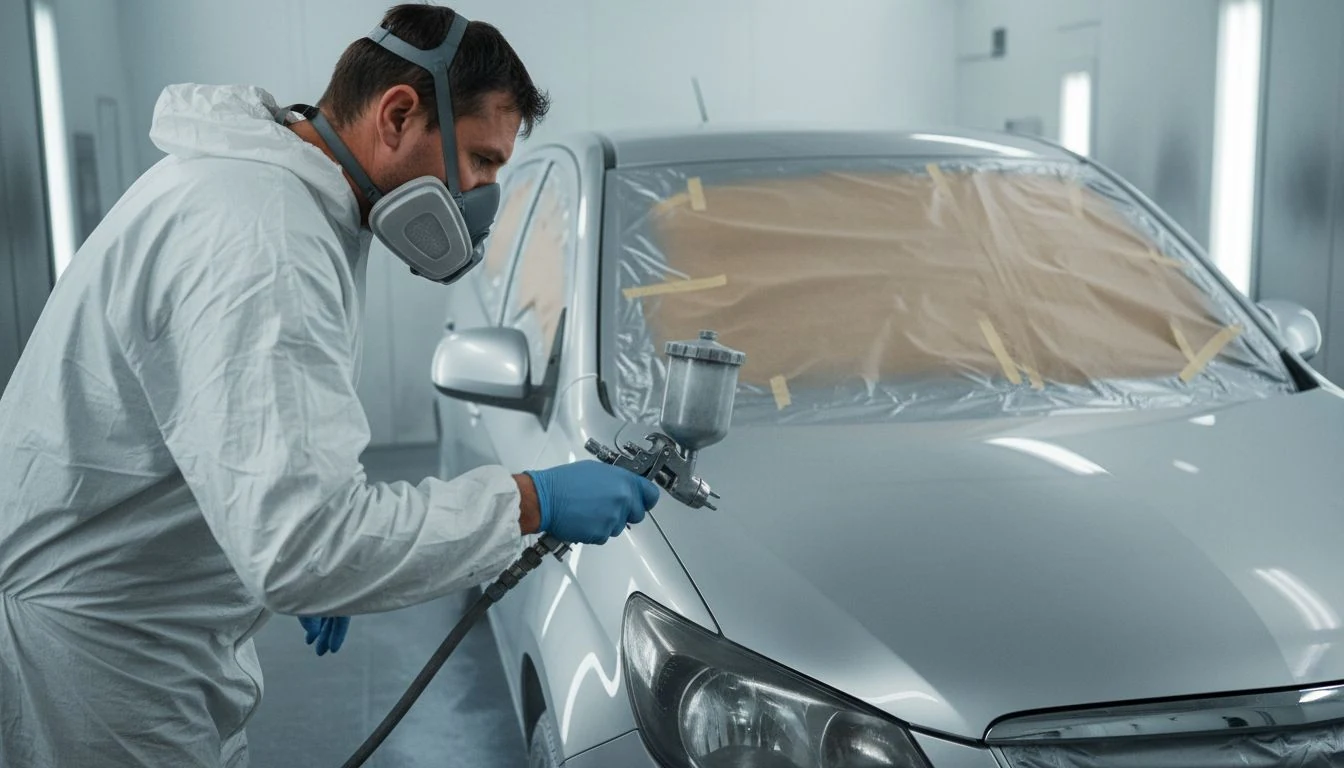
How much does it cost to paint a car? For most people it lands somewhere between $1,000 and $4,500 for a decent full repaint, with bare-bones jobs starting around $300 and show-car work running past $5,000. I learned that the slow way, standing in a body shop lobby with my old silver Corolla outside and a hood that looked like it had a sunburn.
The clear coat on that hood had been flaking for two summers. I kept telling myself it was cosmetic, and it was, until a buyer offered me a lot less for the car because of it. So I got four quotes, built a little sinking fund, and figured out which tier was worth paying for. Here’s everything I wish someone had laid out for me, with the real price ranges and how to plan for them without wrecking your budget.
How much does it cost to paint a car, by quality tier
Paint jobs come in three rough levels, and the price jump between them is mostly about prep work and labor, not the paint itself. These are the ranges AAA’s auto repair guide uses, which matched my quotes pretty closely:
- Basic: $300 to $1,000. One coat, minimal prep, no clear finish. Door jambs and other hidden spots usually stay the old color.
- Mid-grade: $1,000 to $4,500. Better sanding and prep, higher-quality paint, multiple coats. This is the family-car repaint most of us actually need.
- High-end: $5,000 to $20,000. Sanding down to bare metal, premium paint, multiple coats, custom effects. Think restorations and car-show builds.
My four quotes for a full repaint of a compact sedan came in at $850, $2,400, $2,900 and $6,200. The $850 shop was honest about it: they’d scuff, spray, and send me home. The $6,200 shop wanted to take panels off and strip them. Neither of those fit the problem I had.
Size matters too. AAA puts small cars at roughly $2,000 to $3,500 and larger SUVs or trucks at $3,500 to $7,000 for the same quality of work, simply because there’s more surface to sand and spray.
What actually drives the price up
When I asked the $2,400 shop why the $6,200 quote was so much higher, the owner walked me around my own car and pointed at things I’d never noticed. Most of the bill is hours. Paint is a small slice of it.
- Prep work. Sanding, filling chips and masking take the most time. More prep means a longer-lasting finish and a bigger invoice.
- Existing damage. AAA lists minor dents at $50 to $150 each, rust spots at $150 to $500, and deep scratches at $150 to $300. Those get fixed before any paint goes on.
- Color changes. Going from silver to green means painting the jambs, under the hood and inside the trunk lid. Matching your existing color is much cheaper.
- Finish. Matte can add $2,000 to $6,000 over a regular gloss finish. Metallic flake adds a few hundred more.
- Where you live. Body shop labor rates in a big metro area can run well above a small-town shop.
Labor keeps getting pricier, too. The Bureau of Labor Statistics index for motor vehicle repair prices was about 3.5% higher in September 2026 than a year earlier. A quote you got last spring is probably a little stale.
Full repaint, one panel, or a wrap?
Before you ask how much it costs to paint a car top to bottom, ask whether the whole car needs it. Mine didn’t. The hood and roof were bad and the doors were fine.
Painting a single panel or a damaged area costs far less than a full respray, because the shop only preps and blends one section. My hood-and-roof quote from the mid-grade shop was $1,150, less than half of their full-car price. The tradeoff is color matching on older paint, which a good shop handles by blending into the panels next to it.
Wraps are the other option people bring up. AAA puts a basic vinyl wrap at $500 to $5,000. A wrap can protect the paint underneath and comes off later, but it won’t hide peeling clear coat for long, and it usually doesn’t last as long as real paint. If your paint is failing, a wrap is a costume over the problem.
The cheapest paint job is the one you only have to pay for once. I almost picked the $850 quote, and I’d have been back in two years.
Is a paint job worth it on an older car?
This is the question I spent the most time on, and I’d rather give you my honest take than a neat formula. It depends on what you plan to do with the car.
If you’re keeping it another five years or more, a mid-grade repaint can make sense, especially if rust is starting where paint has failed. Rust spreads. Paint that’s peeling down to bare metal is where it starts.
If you’re selling within a year, run the numbers first. Look up the private-party value with and without the paint issue (a listing site and a couple of dealer trade-in offers will tell you). In my case the gap was roughly $1,200, and my partial repaint cost $1,150. Basically a wash on money, but the car sold in four days instead of sitting.
And if the car is worth less than the paint job? Skip it. Put that money toward your next car instead. I mean that kindly. There’s no prize for repainting a car you’re about to replace.
How to budget for a paint job without a credit card
I didn’t have $1,150 sitting around for a hood. I had a car that still drove fine, which meant I had time. That’s the best position to plan from, because a cosmetic repair can wait a few months while you save.
- Get three written quotes. Ask each shop what’s included: how many coats, whether they paint the jambs, and how long the warranty runs.
- Pick a target and a date. My target was $1,200 (quote plus a small cushion) in five months.
- Divide it into paychecks. $1,200 over 10 biweekly paychecks is $120 each. I set up an automatic transfer the morning after payday.
- Give it its own bucket. I opened a separate savings account labeled “car paint” so it wouldn’t blend into my emergency fund. A car sinking fund is one of the categories I keep year-round now.
- Book the shop when the money’s there. Paying cash also gave me a little leverage. The shop took $50 off for paying up front.
If you already set money aside for repairs, check how a paint job fits next to the bigger stuff. My car maintenance budget covers oil, tires and brakes first. Paint is a want until rust makes it a need.
Cozy tip: Name the savings account after the car and the goal (“Corolla hood, May”). It sounds silly, but a named bucket is a lot harder to raid on a random Thursday. If you like paper, our free sinking fund printable has a little tracker you can color in every payday.
Ways to pay less without getting a bad job
You can trim the bill without picking the shop that cuts every corner. These helped me the most:
- Keep the same color. Skipping a color change saved me the jambs and under-hood work.
- Do the small prep yourself only if the shop agrees. Some shops will knock off a bit if you remove trim or wash the car properly. Others would rather do it themselves. Ask.
- Paint only what’s failing. Partial jobs on the worst panels cost a fraction of a full respray.
- Ask about the warranty in writing. A cheaper job with no warranty can cost more in two years than a mid-grade job with one.
- Check your insurance first if it’s accident damage. If the paint damage came from a collision, a claim may cover it. Your car insurance deductible decides whether that’s worth filing.
One thing I wouldn’t do again: rattle-can the hood myself. I tried on a small spot first. It looked fine from ten feet and terrible from two.
How much does it cost to paint a car on a savings plan?
Here is how the monthly savings target changes by tier. These are example numbers using the AAA ranges above, not quotes for your car, so plug in your own estimate.
| Job | Example quote | Save over | Per month | Per biweekly paycheck |
|---|---|---|---|---|
| Basic full repaint | $800 | 4 months | $200 | $92 |
| Partial (hood + roof) | $1,200 | 5 months | $240 | $111 |
| Mid-grade full, small car | $2,800 | 8 months | $350 | $162 |
| Mid-grade full, SUV or truck | $4,500 | 12 months | $375 | $173 |
| High-end restoration | $8,000 | 18 months | $444 | $205 |
Common mistakes when budgeting for a paint job
- Comparing quotes that don’t include the same work. An $800 quote and a $2,800 quote often describe two different jobs. Ask for coats, prep and warranty in writing before you compare.
- Forgetting the damage repair line. Dents, rust and scratches get fixed before paint, and they can add hundreds to the final bill.
- Pulling the money from your emergency fund. A paint job is almost always something you can schedule. Save for it separately so a real emergency doesn’t find an empty account.
If you want to see how car costs stack up against everything else people spend on, I keep a running list of budgeting statistics that puts transportation in context. And if a paint job has you rethinking the car altogether, here’s what the average car payment looks like right now. More money-planning posts live in our budgeting section.
Frequently Asked Questions
How much does it cost to paint a car at Maaco?
Maaco doesn’t publish set prices online. Their site says you get a free estimate and choose a package based on your car’s condition. Their budget packages generally fall in the basic tier, and higher packages with more prep move into mid-grade pricing. Get the quote in writing with the number of coats listed.
Is it cheaper to wrap or paint a car?
A basic wrap can cost less than a quality repaint (AAA lists wraps at $500 to $5,000). But a wrap won’t fix failing paint underneath and usually doesn’t last as long. If your clear coat is peeling, paint is the real fix.
How long does a car paint job take?
A basic job can be done in a day or two. A mid-grade repaint with real prep usually takes several days to about a week. High-end work can take weeks, especially when panels come off.
Does a new paint job increase a car’s value?
It can help the car sell faster and close a gap a buyer would otherwise negotiate down, but you rarely get the full cost back. Compare the value with and without the paint issue before you pay for it.
Can I paint my car myself to save money?
You can, but it takes space, safety gear and a lot of patience to get a smooth finish. Small touch-ups are doable. A full repaint at home rarely looks like shop work, and fixing a bad DIY job costs more.
Grab my free Monthly Budget Template
The same cozy spreadsheet I use to track every dollar — sinking funds, bills, and savings, all in one place. Join the newsletter and I’ll send it straight to your inbox.
No spam, ever. Unsubscribe anytime. — Nora
Keep reading — more on Budgeting Methods