
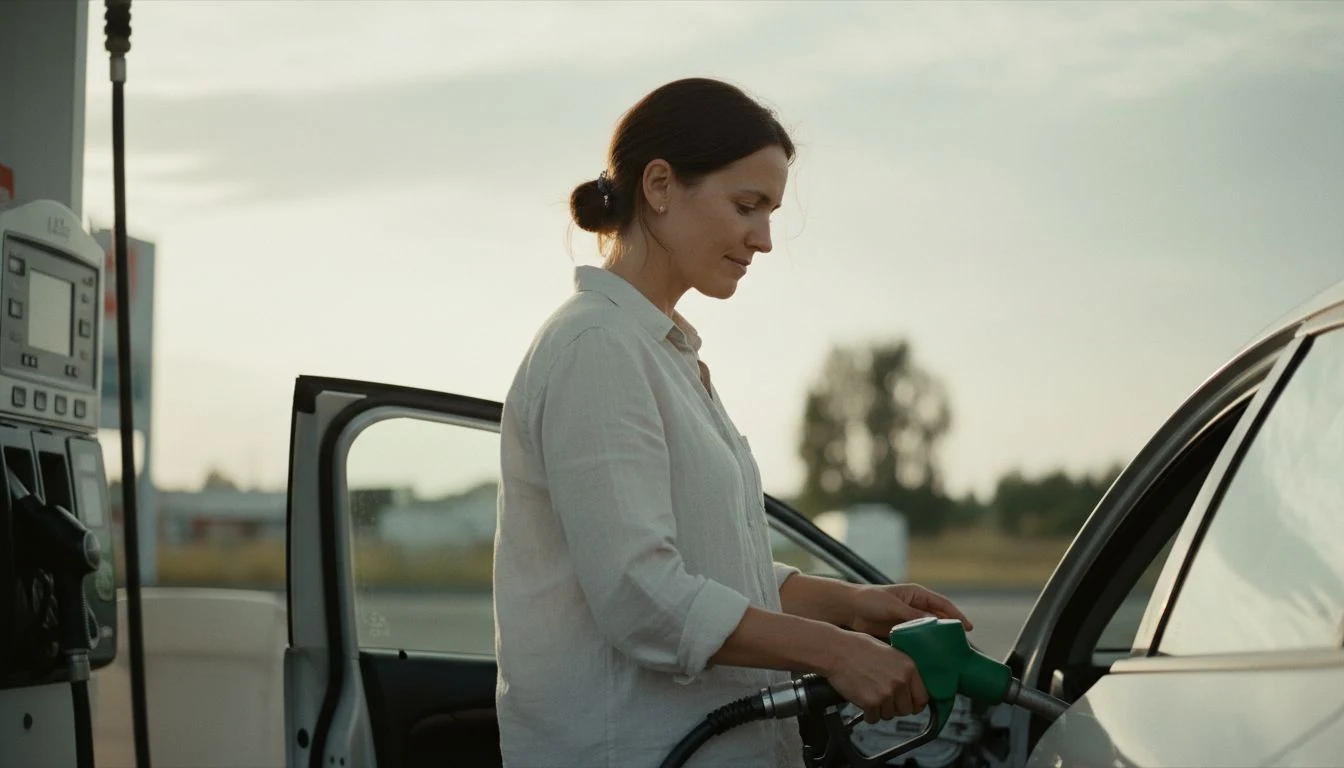
Ways to save money on gas used to feel like one of those things I couldn’t touch. The number at the pump was the number, and I just paid it and drove off a little grumpier.
Then I actually looked. Not at coupons or some app that promised me pennies, but at my own habits — how I drove, when I filled up, where I filled up, and how much dead weight I was hauling around for no reason. Over about three months my monthly fuel spend dropped from roughly $260 to $198. That’s $62 a month I get to keep, and I didn’t sell my car or start biking to work in July. Here’s exactly what moved my number, and the stuff that turned out to be a waste of my time.
Your gas budget is a driving habit, not a gas price
I want to start here because it changed how I think about the whole thing. You can’t control what a gallon costs. That’s set by refineries and crude oil and things happening on the other side of the planet. What you can control is how many gallons you burn to live your normal life.
That reframe is why the best ways to save money on gas have almost nothing to do with the price sign. For most of us, a big chunk of the waste is invisible. Fast starts, hard braking, idling in a drive-thru, a trunk full of stuff you keep meaning to take inside. According to the U.S. Department of Energy’s fuel economy driving tips, aggressive driving alone can lower gas mileage by 15% to 30% at highway speeds. That’s not a rounding error. That’s your whole savings hiding in your right foot.
So when I say I found real ways to save money on gas, I don’t mean I got lucky with prices. I mean I stopped donating fuel to habits I never noticed I had.
The ways to save money on gas that actually moved my number
Let me get straight to the ones that earned their spot. These are ranked by what did the most for me, not by what sounds clever.
- I slowed down on the highway. I used to sit at 78 on my commute. I dropped to about 68. Every 5 mph over 60 is like paying roughly 20 cents more per gallon, and honestly I got to work two minutes later. Two minutes. This one alone I’d guess saved me $20 a month.
- I stopped idling. Waiting to pick up my niece from practice, I’d leave the car running for the AC. Ten minutes here, fifteen there. Idling burns a quarter to half a gallon an hour and gets me zero miles. Now I roll the windows down or shut it off.
- I checked my tire pressure. This is the boring one everyone skips. Two of my tires were about 6 PSI low. Underinflated tires drag, and correcting them can improve mileage by around 3%. Free at any gas station air pump.
- I cleaned out my trunk. I was carrying a case of water, a folding chair, and a box I’d been “about to return” for a month. An extra 100 pounds can nick your mileage by about 1%. It adds up when the weight lives there permanently.
- I combined my trips. A cold engine uses way more fuel. Instead of four separate little outings, I started stacking errands into one loop while the car was already warm.
None of these cost a dollar. That’s the part that got me. I kept waiting for the trick to require a purchase, and it just… didn’t.
Fill up on the right day (and skip the myth about the wrong one)
You’ve probably heard you should always fill up early on a certain weekday. It’s a little more nuanced than that, but there’s a real pattern. Prices tend to creep up heading into the weekend because that’s when demand rises. Filling up mid-week, Monday through Wednesday, usually catches a slightly better price in a lot of markets.
I set a soft rule: I fill up Tuesday morning if I’m near a quarter tank, not Friday afternoon when I’m running on fumes and forced to take whatever’s in front of me. The savings per fill-up are small, a couple bucks, but I fill up maybe three times a month, so it compounds.
The myth I did let go of: filling up when it’s cold outside to “get more gas.” Technically fuel is denser cold, but the difference is so tiny you’d never see it on a receipt. Not worth planning your life around.
Use the boring apps, skip the flashy ones
I’m picky about apps because I don’t want another thing pinging me. But two earned a spot on my phone.
A price-finder app (GasBuddy is the one most people know) shows you the cheapest stations near you in real time. The catch is you have to actually be willing to route to a cheaper one, and only if it’s on your way. Driving eight minutes out of your way to save eleven cents a gallon is a loss, not a win. Do that math before you feel clever about it.
The other is my grocery store’s fuel rewards. I already shop there, so the points I earn knock 10 to 30 cents off a gallon roughly once a month. That’s genuinely free money because I’m not changing anything. If your store has a fuel program and you’re not enrolled, that’s the first five minutes to spend today.
The best gas app is the one that saves you money without making you drive further to use it.
Where the money actually went: a labeled example
I’m a numbers person, so let me show you the before-and-after instead of just telling you it worked. This is my real fuel spend, rounded, over a month with about 900 miles of normal driving. Your car, commute, and local prices will land differently — but the shape of it should look familiar.
| Change I made | Monthly savings | Cost to start | Effort |
|---|---|---|---|
| Highway speed (78 to 68 mph) | ~$20 | $0 | Easy |
| Store fuel rewards + mid-week fills | ~$18 | $0 | Easy |
| Cut idling while parked | ~$12 | $0 | Easy |
| Tire pressure corrected | ~$8 | $0 | 5 minutes |
| Emptied ~100 lb from trunk | ~$4 | $0 | 5 minutes |
| Total (from $260 to $198) | ~$62 | $0 | One afternoon |
Sixty-two dollars isn’t life-changing on its own. But I moved that straight into a small car-maintenance sinking fund, and now the next oil change doesn’t wreck a paycheck. That’s the whole cozy-budget move: catch a leak, give the money a job.
Three mistakes that quietly cost me gas money
- Chasing cheap gas across town. I once drove 12 minutes to save nine cents a gallon. On a 12-gallon fill that’s about a dollar saved and more than a dollar of gas burned getting there. If it’s not on your route, it’s not a deal.
- Buying premium my car didn’t need. Unless your owner’s manual actually requires premium, regular is fine, and premium is often 40 to 60 cents more per gallon for zero benefit. I was doing this for months because I thought it was “nicer.”
- Letting the tank run to empty. Running on fumes means I fill up wherever I’m stranded, at whatever price, on whatever day. Desperation is expensive. A quarter-tank rule gives me the freedom to wait for a better price.
Bigger levers, if you’re ready for them
Everything above is free and quick. If you want to go further, these move more but ask more of you.
- Carpool one or two days a week. Splitting a commute even twice a week can cut that portion of your fuel almost in half. I trade off with a coworker who lives four blocks over.
- Batch your driving into fewer days. I started doing all my errands on one “car day” and keeping other days closer to home. Fewer cold-engine starts, fewer miles.
- Right-size the car when it’s time. This isn’t a today move, but the next time you replace a vehicle, fuel economy is one of the biggest long-term savings you’ll ever lock in. A car that gets 32 mpg instead of 22 is real money every single week for years.
You don’t have to do the big ones to win. I mostly stuck with the small stuff, and it still gave me back that $62. Start where it’s easy.
Cozy tip: pick just one change from this list this week — I’d start with tire pressure and your store’s fuel rewards, because both are free and take ten minutes. Then send whatever you save straight into a tiny “car stuff” sinking fund. If you want a place to track it, grab my free monthly budget printable and give that saved gas money a home before it wanders off.
How this fits your whole budget
Gas is one of those sneaky variable costs that never shows up as one big scary bill, so it never gets audited. It just quietly drips $30 or $60 a month out of your checking account. When I finally treated it like a real line item, it joined the list of small leaks I’ve plugged, right next to my electric bill and my grocery runs.
If you want the full picture of where regular people actually lose and save money, I keep a running page of budgeting statistics that honestly surprised me. And gas is really just one spoke of a bigger wheel — you can find the rest in my roundup of money saving tips that work, or browse everything in the saving money section when you’ve got a slow afternoon.
None of this is about being cheap. The best ways to save money on gas are really just the habit of not overpaying for the exact same life. If national prices matter to your planning, the U.S. Energy Information Administration publishes weekly gas price data so you can see the trend for yourself instead of guessing.
Frequently Asked Questions
What’s the single best way to save money on gas?
Slow down on the highway. Dropping from around 78 to 68 mph did more for my mileage than anything else, and it’s completely free. Every 5 mph over 60 is roughly like paying an extra 20 cents per gallon, so easing off the pedal is the fastest win.
Does filling up in the morning really save money?
Temperature timing is basically a myth — fuel is denser when cold, but the difference is too small to notice on a receipt. What matters more is the day. Prices often creep up before the weekend, so filling up Monday through Wednesday usually beats a Friday-afternoon fill.
Is premium gas worth it for saving money long-term?
Only if your owner’s manual specifically requires premium. If it doesn’t, regular is completely fine and premium just costs you 40 to 60 cents more per gallon for no benefit. I wasted months on premium my car didn’t need.
Do gas rewards apps actually save you money?
They can, but only if you don’t drive out of your way to use them. A grocery-store fuel rewards program you’re already earning is free money. Driving ten minutes to a cheaper station usually burns more gas than it saves, so run the math first.
How much can I realistically save on gas each month?
For me it was about $62 a month on roughly 900 miles of driving, using only free changes like tire pressure, speed, less idling, and store rewards. Your number depends on your car and commute, but $30 to $60 is a realistic range for most people without buying anything.
Grab my free Monthly Budget Template
The same cozy spreadsheet I use to track every dollar — sinking funds, bills, and savings, all in one place. Join the newsletter and I’ll send it straight to your inbox.
No spam, ever. Unsubscribe anytime. — Nora
Keep reading — more on Saving Money