
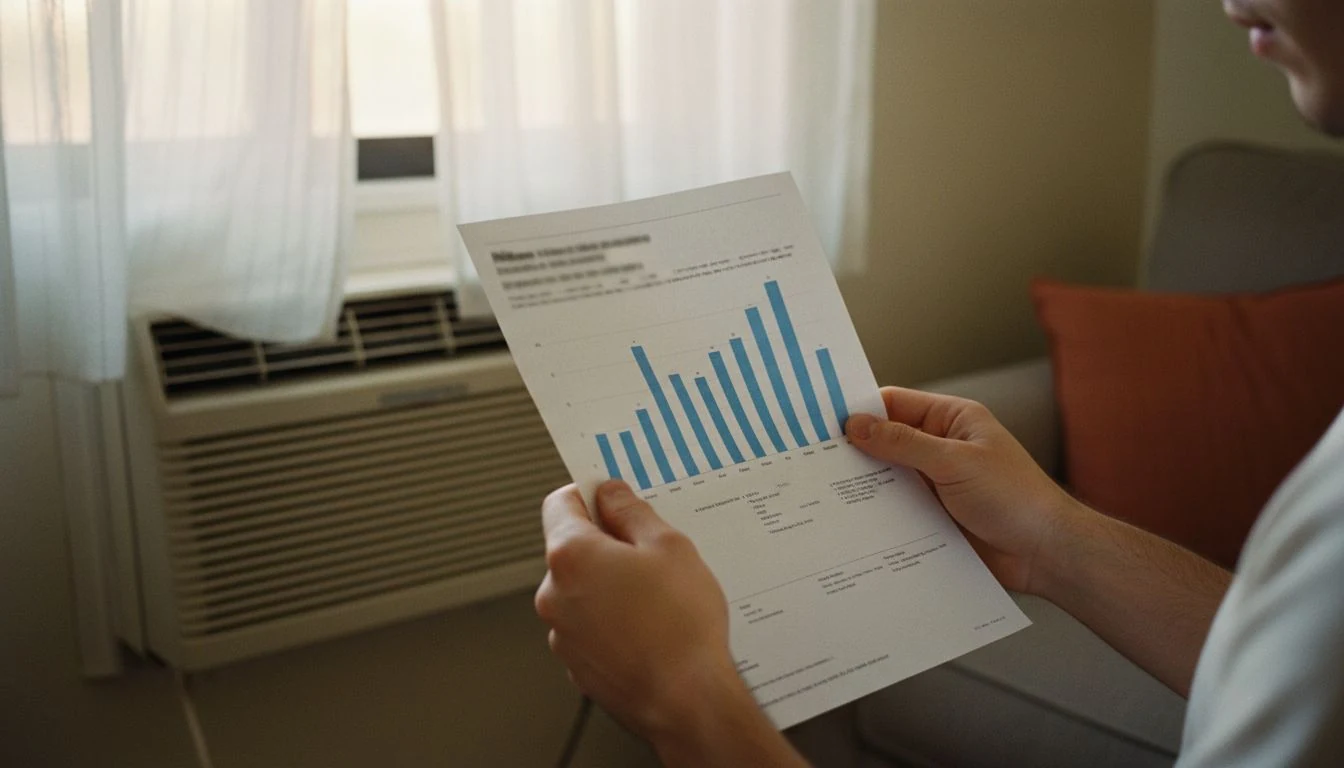
The average electric bill in the U.S. was $142.26 a month in 2024, the latest full year the Energy Information Administration has finalized. That bought the typical home 863 kilowatt-hours. Prices have kept climbing since, so the same month of power costs closer to $157 in 2026.
I used to open my electric bill, look at the total, feel a small jolt, and close it. I never looked at the kWh line, which is the only number that tells you whether you’re using a lot or just paying a lot. Those are two different problems with two different fixes. Below you’ll find the national benchmark, what a normal month of kWh actually looks like for your size of home, why July and April look nothing alike, and how to set an electric line in your budget that doesn’t blow up every summer.
The average electric bill in 2026, and the 2024 number everyone quotes
The EIA collects bills from every electric utility in the country and publishes the average residential bill by state once a year. The 2024 national figures, final:
- Average monthly bill: $142.26
- Average monthly use: 863 kWh
- Average price: 16.48 cents per kWh
That’s the number you’ll see quoted everywhere. It’s also a year and a half old.
The EIA’s monthly report tracks prices much closer to today. In its Electric Power Monthly price table, the average residential price for January through June 2026 was 18.16 cents per kWh. June alone was 18.34 cents. In 2025 the full-year average was 17.30.
My own back-of-the-envelope math, and it is my math, not an official EIA bill figure: the same 863 kWh at 18.16 cents comes to about $156.77 a month. Same house, same habits, roughly $14 more than in 2024. If your bill crept up this year and you didn’t change a thing, that’s probably why.
I spent years trying to fix my electric bill before I checked which half of it was big: the kWh or the price.
Average kWh usage per month: what a normal month looks like
The national average kWh usage per month is 863 kWh, per the EIA’s 2024 billing data. But almost nobody is the average household. Size of home and number of people swing it more than anything you do with a light switch.
For a finer breakdown I went to the EIA’s Residential Energy Consumption Survey, which measures how much electricity different kinds of homes use. The most recent edition covers 2020. It reports use in British thermal units, so I converted it to kWh (one kWh is 3,412 Btu). Roughly:
- Apartment in a building with 5+ units: about 508 kWh a month
- Apartment in a 2-4 unit building: about 554 kWh
- Townhouse or other attached single-family: about 703 kWh
- Detached single-family house: about 1,033 kWh
- Mobile home: about 1,038 kWh
Household size moves it too. A one-person home used about 598 kWh a month. Two people, about 887. Four people, about 1,089.
And one detail I didn’t expect: homes that heat with electricity averaged around 1,089 kWh a month, while homes heating with natural gas averaged about 752. If your heat is electric, a “high” kWh number in winter may be normal for you.
The average electric bill for a 1 bedroom apartment
The EIA doesn’t publish bills by bedroom count, so any exact “1 bedroom” figure you see online is someone’s estimate. Here’s mine, built from the closest real data. A home under 1,000 square feet used about 567 kWh a month in the RECS survey, and apartments in larger buildings about 508.
At the 2026 year-to-date price of 18.16 cents, that works out to roughly $92 to $103 a month for a typical one-bedroom. In a high-rate state it could be much more. In California, where the 2024 average price was 31.97 cents, 508 kWh would be about $162.
When I lived alone in a small one-bedroom, my spring bills were low enough to ignore. Then I bought a window air conditioner in June, ran it all day with the door to the bedroom open, and my July bill came in at nearly double my April one. Nothing was wrong with the apartment. I was paying to cool a room I never sat in.
If you’re moving and trying to guess, ask the landlord or the utility for the unit’s last 12 months of bills. Many utilities will share the history for an address. That beats any national average, mine included.
Why the average electric bill in your state can be half or double
The state table is where this gets interesting, because expensive states got expensive in opposite ways. A few 2024 rows from the EIA:
- Hawaii: 495 kWh a month at 42.86 cents = $212.12
- California: 503 kWh at 31.97 cents = $160.86
- Texas: 1,096 kWh at 14.94 cents = $163.72
- Louisiana: 1,202 kWh at 11.73 cents = $140.96
- Utah: 774 kWh at 12.22 cents = $94.57
- New Mexico: 654 kWh at 14.20 cents = $92.88
California and Texas are the pair I keep staring at. Nearly the same bill. But the Californian uses less than half the electricity and pays more than double per kWh. Tell a Californian to “use less” and you’ve missed her problem; in Texas the air conditioner is doing most of the damage, and the rate is fairly ordinary.
That’s why I think the national average is mostly useful as a reality check. Compare yourself to your own state’s row, then figure out whether your usage or your price is the outlier.
The month-by-month shape of an electric bill
Most of us budget electricity like it’s the same every month. It isn’t close. I took the EIA’s national residential electricity sales for each month of 2025 and compared every month to the yearly average. July sold 33% more electricity than an average month. April sold 23% less.
Apply that shape to the $157 estimate and a year looks something like this. These are national patterns, so a Florida home will peak harder in summer and a Minnesota home with electric heat will peak harder in winter:
- January: about $189
- April: about $121
- July: about $209
- August: about $193
- November: about $126
That’s an $88 swing between the cheapest and priciest month for the same household. If your budget has one flat number for electricity, July will feel like an emergency when it’s really just July.
How to compare your own bill to the average
This takes about ten minutes with one bill in front of you, paper or PDF.
- Find the kWh used this billing period. It’s usually near the meter readings or the usage graph. Write it down.
- Divide the total bill by the kWh. That’s your all-in price per kWh, including delivery and fixed charges. Mine was higher than the “rate” printed on the bill because of a flat monthly customer charge.
- Look up your state’s row in the EIA table linked above and compare both numbers: your kWh against the state’s kWh, your price against the state’s price.
- Check the 12-month bar chart most bills print. Compare this month to the same month last year, not to last month.
- Name the outlier. High kWh means a usage fix (cooling, heating, water heater, an old fridge). High price means a plan or rate question, which is a call to your utility.
If your kWh is the problem, I wrote up the ways to save on your electric bill that actually moved my number, and most of them are about cooling. If the whole bill is more than your income can carry right now, look into LIHEAP, the home energy assistance program. Getting help with a utility bill is nothing to be embarrassed about.
What to budget for electricity so summer doesn’t wreck the month
My approach now is simple. I take my last 12 bills, add them up, and divide by 12. That monthly number goes into the budget every month, even in April when the actual bill is small. The difference sits in a little sinking fund, and in July the extra is already there.
No history yet? Use the estimates from this post as a starting point, then round up. For a one-bedroom I’d budget $110. For a family house, somewhere around $175 to $200 in a moderate state. Adjust after three real bills.
Another option is budget billing (some utilities call it levelized or average billing), where the utility spreads your yearly cost into equal payments. It’s handy if you truly can’t keep a cushion. Just know that most programs “true up” once a year, so a hot summer can still show up as a bigger bill later.
Electricity is one line in a bigger picture. My breakdown of the average utility bill, line by line covers gas, water, and trash too, and my roundup of budgeting statistics shows how housing and utilities stack up against the rest of the average paycheck.
Cozy tip: Pull up your last electric bill tonight and write two numbers on a sticky note: kWh used and total paid. That’s it for today. Next month you’ll have a comparison, and in three months you’ll know your real electric line. If you want a place to track it, the free printable budget template has a spot for every bill.
Estimated 2026 electric bill by home type
Here’s the whole benchmark in one place. Usage comes from the EIA’s RECS survey converted to kWh; the dollar column is my estimate at the January-June 2026 average price of 18.16 cents per kWh. Treat it as a starting point, not a quote.
| Home or household | Typical kWh per month | Estimated monthly bill at 18.16 cents |
|---|---|---|
| Apartment, 5+ unit building | ~508 | ~$92 |
| Home under 1,000 sq ft | ~567 | ~$103 |
| One-person household | ~598 | ~$109 |
| U.S. average (EIA 2024 billing data) | 863 | ~$157 |
| Two-person household | ~887 | ~$161 |
| Home of 1,500-1,999 sq ft | ~918 | ~$167 |
| Detached single-family house | ~1,033 | ~$188 |
| Home heated with electricity | ~1,089 | ~$198 |
| Home of 3,000+ sq ft | ~1,290 | ~$234 |
Common mistakes when comparing to the average electric bill
- Comparing your July bill to a yearly average. Summer runs about a third above an average month nationally, so a high July bill can be normal for you.
- Looking only at the dollar total. Two identical bills can come from opposite problems, heavy use at a low rate or light use at a high rate, and the fixes are different.
- Budgeting a flat monthly amount with no cushion. Without a 12-month average or a small sinking fund, the peak months end up on a credit card.
If you’re building out those cushions, my list of sinking fund categories has a spot for seasonal bills like this one. More posts on trimming the fixed stuff live under saving money.
Frequently Asked Questions
What is the average electric bill per month?
The EIA’s final 2024 data puts the U.S. average residential electric bill at $142.26 a month for 863 kWh. Prices have risen since: the average residential price for January through June 2026 was 18.16 cents per kWh, which puts the same usage at roughly $157 a month.
How many kWh does a house use per month?
The average U.S. home bought 863 kWh a month in 2024. A detached single-family house uses more, around 1,000 kWh, while an apartment in a large building uses closer to 500 kWh, based on the EIA’s Residential Energy Consumption Survey.
What is a normal electric bill for a 1 bedroom apartment?
There’s no official figure by bedroom count, but small homes and apartments use roughly 500 to 570 kWh a month. At 2026 average prices that’s about $92 to $103, and more in high-rate states like California, Hawaii, or New England.
Why is my electric bill so high all of a sudden?
The most common reasons are season (cooling in summer, electric heat in winter), a rate increase, or a longer billing period. Check your kWh first: if it jumped, look at cooling, heating, or a failing appliance. If kWh stayed the same and the total rose, your price went up.
Which state has the highest average electric bill?
In the EIA’s 2024 data, Hawaii had the highest average residential bill at $212.12 a month, followed by Connecticut at $199.66. New Mexico and Utah were among the lowest, at about $93 and $95.
Grab my free Monthly Budget Template
The same cozy spreadsheet I use to track every dollar — sinking funds, bills, and savings, all in one place. Join the newsletter and I’ll send it straight to your inbox.
No spam, ever. Unsubscribe anytime. — Nora
Keep reading — more on Saving Money