
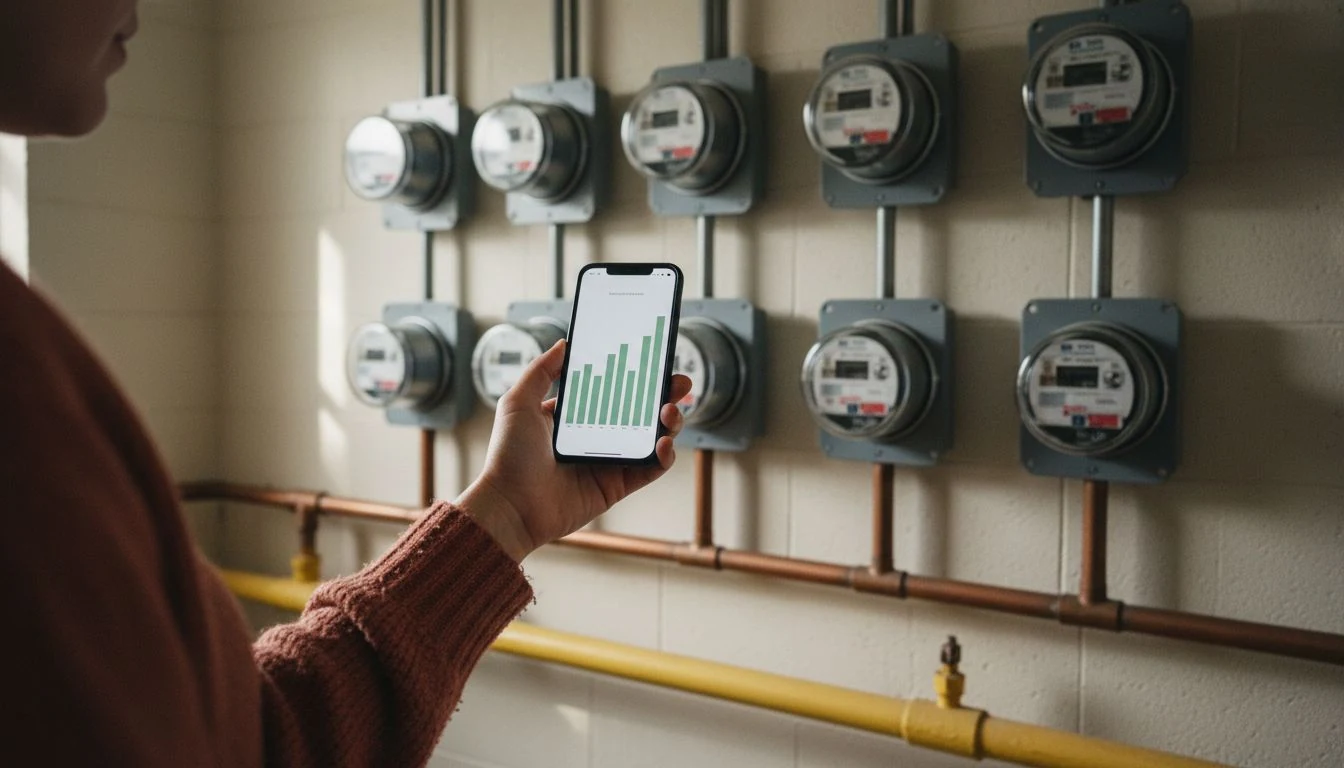
The average utility bill in the U.S. comes to about $395 a month if you count the phone, and about $273 if you don’t. I know, two answers to one question. But which one you hold yourself to decides whether you walk away thinking you’re fine or that something’s wrong.
A few years ago a leasing agent walked us through a one-bedroom and said utilities “run about $150.” I nodded like I knew what that meant. I didn’t. I had no idea what went into that number, which part of it I could control, or whether $150 was cheap. This is the post I wish I’d read before that tour: the national benchmark for every line, what pushes each one up, and which line you can move.
What the average utility bill is (it depends what you count)
The cleanest national number comes from the Bureau of Labor Statistics Consumer Expenditure Survey. In 2024 the average U.S. household spent $4,736 a year on what the government calls “utilities, fuels, and public services.” That’s $394.67 a month.
The total is five lines added together, and one of them surprises people:
- Electricity: $1,833 a year, about $153 a month
- Phone service, landline and cell: $1,460 a year, about $122 a month
- Water, sewer, and trash: $826 a year, about $69 a month
- Natural gas: $493 a year, about $41 a month
- Fuel oil, propane, and other fuels: $125 a year, about $10 a month
The phone is in there. Take it out and the average utility bill for the stuff most of us picture (lights, heat, water, trash) drops to $3,276 a year, or $273 a month. Internet isn’t one of the five lines at all, so if you budget it as a utility the way I do, add it on top.
One more catch. These averages include every household, even the ones whose water is folded into rent and the ones with no gas line. The gas figure looks tiny because a lot of homes pay zero for it. If you heat with gas in a cold state, your January won’t look anything like $41.
The average electric bill: $142, and why yours might be $95 or $212
Electricity is the biggest line for most of us, and it has the best data. The Energy Information Administration publishes the average residential bill by state every year. In its latest release, covering 2024, the U.S. average monthly electric bill was $142.26, for 863 kilowatt-hours at 16.48 cents each.
That one number covers a very wide country:
- Hawaii: $212.12 a month
- Connecticut: $199.66
- Alabama: $173.50
- Colorado: $100.57
- New Mexico: $92.88
What I like about this table is that the expensive states got there by different roads. Households in Hawaii and Connecticut use less electricity than the national average and pay a lot for each kilowatt-hour. Alabama pays a fairly ordinary rate and uses a lot of it, most of that on cooling. Two people with the same $170 bill can have opposite problems.
(BLS says $153 because it measures differently. Close enough for a budget.) If you want the electric line on its own, with kWh by home size and what each month of the year tends to cost, I broke down the average electric bill separately.
Gas, water, and trash: the lines that change with the season
Electricity stays in a range. Gas doesn’t. It’s a curve, and I learned that the expensive way: I once budgeted $95 for heating because $95 was what November looked like, and then January showed up. The full story of that winter, and what got my January bill down to $146, is in how to lower your gas bill.
Water runs the other direction. It climbs in summer with watering and extra showers, then settles in fall. Our July water bill was $91 the summer I went hunting for a leak; by September it was $64. The EPA’s WaterSense program says the average family spends more than $1,000 a year on water costs, which is more than $83 a month.
Trash is the boring one, and I mean that kindly. It’s usually a flat fee, sometimes tacked onto the water bill. And in a lot of cities the sewer charge is calculated off your water meter, so a running toilet can raise two lines at once.
My utility bill is a yearly cost that shows up in twelve pieces of different sizes. I budget it as a year.
Why an apartment’s average utility bill looks nothing like a house’s
This was my question on that apartment tour. The EIA’s Residential Energy Consumption Survey breaks usage down by type of home. In its 2020 survey, an apartment in a building with five or more units used 6,093 kilowatt-hours a year. A detached single-family house used 12,402. Roughly half.
Run those usage numbers at the 2024 average price (my own rough math, not an official figure) and the apartment comes out around $84 a month for electricity, the house around $170. Shared walls do a lot of heating and cooling for free. So do smaller rooms.
Climate splits it again. Homes in hot, humid areas used 13,781 kilowatt-hours a year in that survey, while cold and very cold areas used 9,043. Gas flips it: 750 units a year in the cold regions against 302 in the hot, humid ones. You pay for comfort somewhere; your climate picks the bill.
There’s no official average by bedroom count, so I’d be skeptical of any site that hands you one. You can ask, though. When we moved, I asked the landlord for the unit’s last twelve months of bills and had the electric history that afternoon. It told me more than any average.
How to read your own bill against the average
The routine I use now takes about half an hour, once a year:
- Pull twelve months, not one. Most utilities keep a usage history in your online account. One month tells you about the weather. Twelve tell you about your home.
- Find the fixed charge on each bill. It’s usually called a customer, service, or basic charge. You pay it even in a month you use nothing.
- Divide dollars by usage. Your electric total divided by your kilowatt-hours is your real rate, fees included. If it’s way above 16.48 cents, your problem is price, and that sends you somewhere different than usage does.
- Compare usage, not dollars. Hold your monthly kilowatt-hours against 863 and adjust for your type of home. An apartment at 900 runs high. A house at 900 is doing great.
- Mark your two worst months. Your budget has to survive those, so plan around them.
- Write down the one line furthest from normal. One. That’s where your time goes first.
The first time I did this, the surprise wasn’t electric at all. I’d been paying a fixed monthly fee on a gas line I barely touched from May to September, and I’d never noticed because it was small.
Cozy tip: Give utilities one line in your budget set at the yearly average, plus a tiny sinking fund for the gap. If your year of bills averages $240 but January hits $330, set aside $240 every month and let the mild months fill the fund. If you want somewhere to write all five lines side by side, the free monthly budget printable has a bills section that fits them.
Which line is fixed, which one moves, and where to work on it
I spent years trying to shave the fixed part of these bills while ignoring the part that moves. Where each line sits:
- Electricity. The rate is mostly set for you, though some states let you pick a supplier. Usage is very movable, cooling first. What worked for me is in ways to save on your electric bill.
- Gas. Movable on a calendar. The cheap fixes happen in September. Budget billing smooths the curve into equal payments but doesn’t make the year cheaper.
- Water and sewer. Leaks and habits. My twice-a-year check is in ways to save on your water bill.
- Phone. The most negotiable line here, because it carries add-ons and device payments. I compared it to its own benchmark in what the average phone bill costs.
Trash I leave alone. And if the total is more than you have, that’s a different problem from overuse, with help built for it. The federal home energy assistance program pays part of heating and cooling bills for households under an income limit. I waited a whole winter longer than I should have to look into it.
A benchmark map for every line on your bill
One table to hold your own year of bills against. The monthly figures are yearly averages divided by twelve, so no single month has to match them.
| Line | National average per month | What pushes yours above it | How much you control |
|---|---|---|---|
| Electricity | $142 (EIA, 2024) | Air conditioning, electric heat, a detached house, a high-rate state | Usage: a lot. Rate: little |
| Natural gas | $41 (BLS, 2024, all households) | Gas heat in a cold state, a gas water heater | Seasonal. Most of the work happens before winter |
| Water, sewer, trash | $69 (BLS, 2024) | Household size, watering outside, leaks | Leaks and summer use. Trash is fixed |
| Fuel oil, propane, other | $10 (BLS, 2024, all households) | Rural homes, oil heat | Some. Mostly when you schedule deliveries |
| Phone | $122 (BLS, 2024) | Extra lines, device installments, add-ons | The most. Usually one phone call |
| Total | $395 ($273 without phone) |
Three mistakes that make the average utility bill useless
- Comparing dollars instead of usage. A $190 electric bill is below average in Connecticut and double the average in Utah. Kilowatt-hours compare cleanly across states. Dollars don’t.
- Using one month as your benchmark. That’s how I ended up with a $95 heating budget and a January I wasn’t ready for. Your number is the twelve-month average, and your buffer covers the worst month.
- Comparing yourself to lines you don’t pay. If water and trash come with your rent, your fair comparison is closer to electricity plus gas. Hold yourself to the full $395 and you’ll either panic for nothing or feel smug without earning it.
For bills next to everything else a household spends, see our budgeting statistics roundup.
What to budget for utilities before you’ve seen a single bill
If you’re moving, the number you need doesn’t exist yet. Ask for the unit’s past year of bills first, and ask the utility too, since some will share an address’s usage history. If you get nothing, start from the averages above for your type of home and set your budget line a little over them. I’d rather find $30 left in May than come up $60 short in February.
Then set up the smoothing: one steady monthly amount plus a small fund for the expensive season. My monthly bill tracker is where all five lines live, due dates lined up against paychecks. And if you’re weighing a new place, count utilities as part of the rent when you work out how much you should spend on rent. A cheaper apartment with a big electric bill can cost more than the nicer one.
For the record, we paid less than the $150 that agent quoted. I only knew that because I asked for the history. More guides in the same spirit are in our saving money section.
Frequently Asked Questions
What is the average utility bill per month?
According to the Bureau of Labor Statistics, the average U.S. household spent $4,736 on utilities, fuels, and public services in 2024, about $395 a month. That includes phone service. Without the phone it’s about $273 a month for electricity, gas, water, sewer, trash, and other fuels.
What is the average electric bill?
The EIA puts the average U.S. residential electric bill at $142.26 a month for 2024, for 863 kilowatt-hours at about 16.5 cents each. State averages ranged from about $93 in New Mexico to about $212 in Hawaii.
How much are utilities for a one-bedroom apartment?
There’s no official national average by bedroom count. EIA survey data shows apartments in larger buildings use about half the electricity of a detached house, which at 2024 prices works out to roughly $84 a month for electricity. The most reliable number is the unit’s own history, so ask the landlord or utility for the past twelve months.
Which utilities are usually included in rent?
It depends on the building and the lease. In the apartments I’ve looked at, water, sewer, and trash were the ones most often included, and electricity was almost always separate. Read the lease wording, since “utilities included” can mean one line or all of them.
Why did my utility bill suddenly go up?
Usually the season changed, your rate changed, an estimated reading got corrected by a real one, or something is leaking or running nonstop. Compare the same month last year: if usage is flat and the bill rose, it’s the rate.
Grab my free Monthly Budget Template
The same cozy spreadsheet I use to track every dollar — sinking funds, bills, and savings, all in one place. Join the newsletter and I’ll send it straight to your inbox.
No spam, ever. Unsubscribe anytime. — Nora
Keep reading — more on Saving Money