
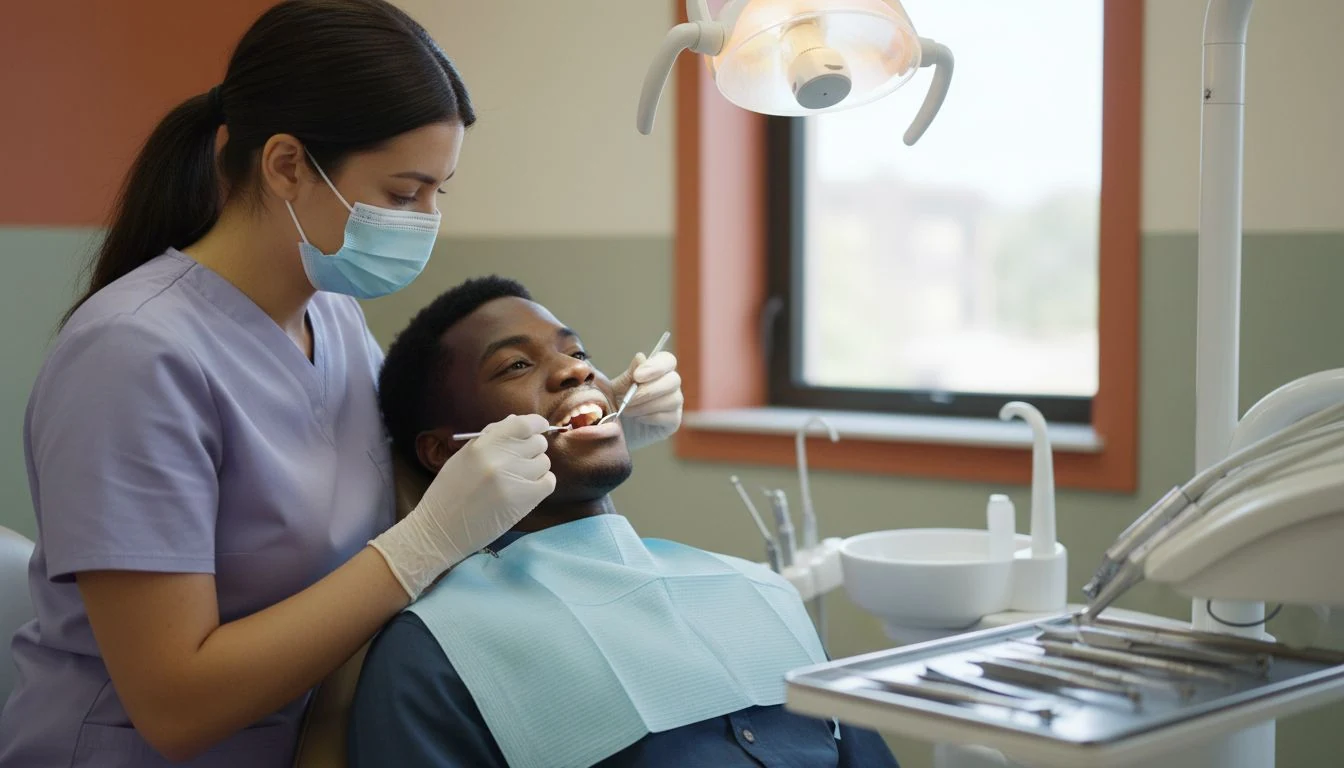
How much does a dental cleaning cost is a question I avoided for two whole years, because I was sure the answer was “more than I have.” I was paying off credit card debt, and skipping the dentist felt like free money.
It wasn’t free. When I finally booked a visit, the cleaning itself was the cheap part. The expensive part was what two years of skipping had turned into. So this is the post I wish I’d read back then: what a cleaning costs with and without insurance, what else shows up on the bill, and why October is the month to book one if you have dental benefits.
How much does a dental cleaning cost without insurance?
The American Dental Association runs a national fee survey, but the recent editions sit behind a paywall. The last full national fee table I could read for free is the ADA’s 2013 Survey of Dental Fees. In it, a routine adult cleaning at a general dentist averaged $85.38, with most offices charging between $65 and $109.
That’s old, so I adjusted it. The Bureau of Labor Statistics tracks a price index for dental services, and it rose about 52% between the 2013 average and August 2026. Apply that to the ADA numbers and you get my working estimate:
- A typical adult cleaning today: about $130
- The cheaper offices (the bottom 10%): around $99
- The pricier offices (the top 10%): around $166
- A child’s cleaning: about $96
Treat those as estimates, not quotes. Big cities and coastal states run higher, and one office in the same zip code can charge 30% more than the one across the street. But when someone asks me how much does a dental cleaning cost without insurance, “$100 to $170, usually around $130” is the answer I trust, because I can show where it came from.
The cleaning is rarely the only line on the bill
This is what caught me. I budgeted for “a cleaning” and got an itemized receipt with four lines on it.
A normal checkup visit usually bundles three things: the cleaning, an exam by the dentist, and X-rays. Using the same 2013 ADA averages adjusted by the BLS index, here’s roughly what each piece runs now:
- Periodic exam for an existing patient: about $69
- Comprehensive exam for a new patient: about $111
- Bitewing X-rays (the four small ones): about $91
- A full set of mouth X-rays: about $188
- Fluoride varnish, if they offer it: about $55
So a regular checkup with bitewings lands near $290 without insurance. And if you’re new to the office and they want the full X-ray set, you’re closer to $430 before anyone mentions a filling.
I’d written $130 in my budget because that’s what the office website listed. Then the exam and X-rays showed up on the receipt, and I sat in the parking lot moving money out of my grocery envelope.
You don’t need bitewings every time. Many offices take them about once a year for adults with healthy teeth. If you’re paying cash, it’s fine to ask, “Are X-rays due today, or can they wait until next visit?”
How much does a dental cleaning cost with insurance?
Often nothing, or close to it. Most dental plans treat cleanings, exams and routine X-rays as preventive care and cover them at or near 100%, usually twice a year. Check your own plan’s summary, because “twice a year” sometimes means “once every six months to the day.”
Plenty of people have that coverage and still don’t use it. According to the ADA’s Health Policy Institute national trends report, 62% of adults had private dental insurance in 2022, yet only about 40% of adults ages 19 to 64 saw a dentist that year. That gap is money people already paid in premiums and then left on the table.
Cost is a big reason. In 2023, 13% of people reported cost barriers to dental care, compared with 4% to 5% for other kinds of health care. Dental is the care people skip first when money’s tight. I know, because I was one of them.
If you’re also sorting out your medical side, I broke down what health insurance costs per month in its own post. Dental is usually a separate plan with its own rules, which is why it’s easy to forget.
Regular cleaning vs. deep cleaning (and why the price jumps)
A regular cleaning is the polish-and-scrape most of us picture. A “deep cleaning” is a different procedure called scaling and root planing, and it’s priced by quadrant, meaning a quarter of your mouth.
In the 2013 ADA survey, scaling and root planing for four or more teeth in one quadrant averaged $232.45. Adjusted to today, that’s about $354 per quadrant. If a dentist recommends it for all four, the math is roughly $1,400 without insurance. Then the follow-up cleanings change too: periodontal maintenance averaged $127.97 in 2013, so about $195 each now, compared with $130 for a regular cleaning.
Two skipped years led to a quote for two quadrants of deep cleaning. I had “saved” maybe $500 in checkups and ended up paying more than that to catch up. I’m not a dentist and I can’t tell you whether you need a deep cleaning. I can tell you that if one gets recommended, it’s fair to ask to see the gum measurements and X-rays behind it, and to ask whether it can be split across two visits (and two paychecks).
Why October is the best month to book a cleaning
A lot of dental plans work on a calendar-year benefit period. Your annual maximum, the most the plan will pay in a year, often resets on January 1. Anything you didn’t use by December 31 is gone. Those maximums tend to be modest, so it’s worth knowing yours before you need a filling.
So if you had one cleaning in the spring and never went back, your second covered cleaning is sitting there unused. Book it now, not in mid-December when every office is slammed with people doing the same math.
Two more year-end deadlines to check:
- A health FSA can pay for dental costs, and those dollars are use-it-or-lose-it unless your employer allows a grace period or carryover. For plans starting in 2026, the IRS caps the carryover at $680, so anything above that can vanish.
- An HSA also pays for dental, but it doesn’t expire. No rush there.
If your plan runs on a different benefit year (some employer plans reset in July), the same logic applies. Just move the deadline.
How I budget for dental cleanings now
After the deep-cleaning bill, I stopped treating the dentist as a surprise. It’s a sinking fund now, same as car registration or holiday gifts. My setup:
- Price the full visit, not the cleaning. Call the office and ask for the cash price of a cleaning, exam and bitewings together. Write that number down.
- Multiply by two. Most people need two cleanings a year. Without insurance, that’s around $580 using the estimates above.
- Divide by 12. $580 a year becomes about $48 a month. I round mine up to $50.
- Add a small “findings” buffer. Even with insurance covering cleanings, fillings usually aren’t free. I keep an extra $15 a month for that.
- Book both cleanings at once. Schedule the next one before you leave the office. It’s the only way I’ve ever actually gone twice in one year.
- Check your benefits every October. Put a calendar reminder for October 1 that says “used both cleanings? FSA balance?”
If money’s tight right now, this is also one of the few medical costs you can plan almost to the dollar. I find that weirdly comforting. Unexpected dental work is a classic reason people drain their emergency fund. A routine line keeps it from getting there.
What a dental cleaning visit really costs, line by line
Each row below starts with the 2013 ADA national average fee for general dentists, then applies the BLS dental services index rise through August 2026 (a factor of about 1.52). These are my estimates for budgeting, not prices you should expect to be quoted exactly.
| Visit type | What’s usually included | 2013 ADA average | Estimated cost today | Monthly set-aside (2 visits/yr) |
|---|---|---|---|---|
| Cleaning only | Adult cleaning | $85 | $130 | $22 |
| Routine checkup | Cleaning + periodic exam | $131 | $199 | $33 |
| Checkup with X-rays | Cleaning + exam + bitewings | $191 | $290 | $48 |
| New patient visit | Cleaning + comprehensive exam + full X-rays | $282 | $429 | n/a (once) |
| Child’s checkup | Child cleaning + exam + fluoride varnish | $145 | $220 | $37 |
| Gum maintenance visit | Periodontal maintenance + exam | $174 | $264 | $44 |
| Deep cleaning, full mouth | Scaling and root planing, 4 quadrants | $930 | $1,414 | n/a (one-time) |
Common mistakes when budgeting for a dental cleaning
- Budgeting for the cleaning instead of the visit. The exam and X-rays can more than double the bill, so price all three together.
- Letting the second covered cleaning expire. If your plan pays for two a year and resets January 1, an unused fall cleaning is money you already paid for in premiums.
- Skipping visits to save money. That’s the one I made. A $290 checkup avoided can turn into a $1,400 deep cleaning later, and I paid that difference myself.
Ways to pay less for a dental cleaning
If you don’t have dental insurance, you still have options. These are the ones I’d look at first:
- Dental hygiene schools, where students clean teeth under supervision, often for a small fraction of the usual price. It takes longer, and I’d still go.
- Community health centers. Many federally funded health centers offer dental care on a sliding scale based on income. You can search by zip code with HRSA’s Find a Health Center tool.
- In-office membership plans. A lot of independent practices sell a yearly plan that covers two cleanings, exams and X-rays for one flat fee. Compare it to the $580 estimate above before signing up.
- The cash price. Some offices discount if you pay the same day. Ask before the appointment, not at checkout.
And if a bill already landed that you can’t cover, the same tactics from my post on how to negotiate medical bills apply to dental offices too. Ask for the itemized bill, ask for a payment plan, and ask whether there’s a prompt-pay discount.
Cozy tip: before October ends, log into your dental plan and look at one number: how many covered cleanings you have left this year. If the answer is one, book it this week. Then add a dental line to your sinking funds so next year’s visits are already paid for. The free monthly budget printable has a sinking fund section that fits this perfectly, and there’s more on setting up lines like this under budgeting.
Frequently Asked Questions
How much is a teeth cleaning without insurance?
Roughly $100 to $170 for the cleaning alone, with about $130 as a typical figure. That estimate comes from the ADA’s 2013 national fee survey adjusted by the BLS dental services price index through August 2026. With an exam and bitewing X-rays, a routine visit is closer to $290.
Does dental insurance cover cleanings at 100%?
Many plans do. Cleanings, exams and routine X-rays are usually classified as preventive care and covered at or near 100%, typically twice per year. Some plans require six months between visits, so check your plan’s frequency rules before booking.
How much does a deep cleaning cost?
Deep cleaning (scaling and root planing) is priced per quadrant. The ADA’s 2013 average was $232.45 per quadrant, which works out to about $354 today using the BLS dental price index. A full mouth, all four quadrants, runs around $1,400 without insurance.
How often should you get your teeth cleaned?
Most adults go every six months, which is also what most dental plans cover. Your dentist may recommend more frequent visits if you have gum disease. It’s worth following that schedule, because skipped cleanings can turn into more expensive treatment later.
Do dental benefits reset every year?
Yes, most plans have an annual maximum that resets at the start of the benefit year, usually January 1. Unused cleanings and unused coverage don’t roll over, which is why fall is a smart time to book any cleaning you haven’t used yet.
If you like seeing where the numbers come from, I keep a running page of budgeting statistics built from primary sources like these. And for context on the whole year, the AHRQ’s Medical Expenditure Panel Survey found that people who saw a dentist spent an average of $887 on dental care in 2021, cleanings and everything else combined.
Grab my free Monthly Budget Template
The same cozy spreadsheet I use to track every dollar — sinking funds, bills, and savings, all in one place. Join the newsletter and I’ll send it straight to your inbox.
No spam, ever. Unsubscribe anytime. — Nora
Keep reading — more on Budgeting Methods