
Ways to save on water bill was the exact thing I typed into my phone at 11pm, sitting on the kitchen floor, holding a July statement for $91. My winter bills ran about $58. I had no idea what changed.
Turns out most of it was two things I could have found in an afternoon: a toilet that was quietly running and a sprinkler timer set by someone who apparently hated money. By September my bill was $64. That’s $27 a month back, and I didn’t take shorter showers or install anything fancy. Here’s what I actually checked, in the order I’d check it again, plus the thing I wasted $40 on first.
Your water bill is not really about your showers
This is the part nobody leads with, so I will. Showers get all the guilt and almost none of the money.
The EPA’s WaterSense program puts it plainly: the average American family uses more than 300 gallons of water per day at home, and roughly 70 percent of that happens indoors. Which means about 30 percent of what you pay for never enters your house at all. It goes on the lawn. In dry parts of the country that outdoor share climbs a lot higher, mostly because of landscape irrigation.
If you’re standing in the shower doing math about whether to rinse your conditioner, you’re auditing the wrong room. I did that for a year. Meanwhile a rubber flapper the size of a coaster was costing me more than my whole shower habit.
You can see the national breakdown yourself on the EPA’s how we use water page. It reframed the whole thing for me.
Ways to save on water bill, ranked by what actually worked
These are in the order they moved my number, not the order that sounds most virtuous.
- I replaced a running toilet flapper. Nine dollars at the hardware store, about fifteen minutes, no plumber. This was far and away the biggest single line. A toilet that runs on and off all day is a faucet you can’t hear.
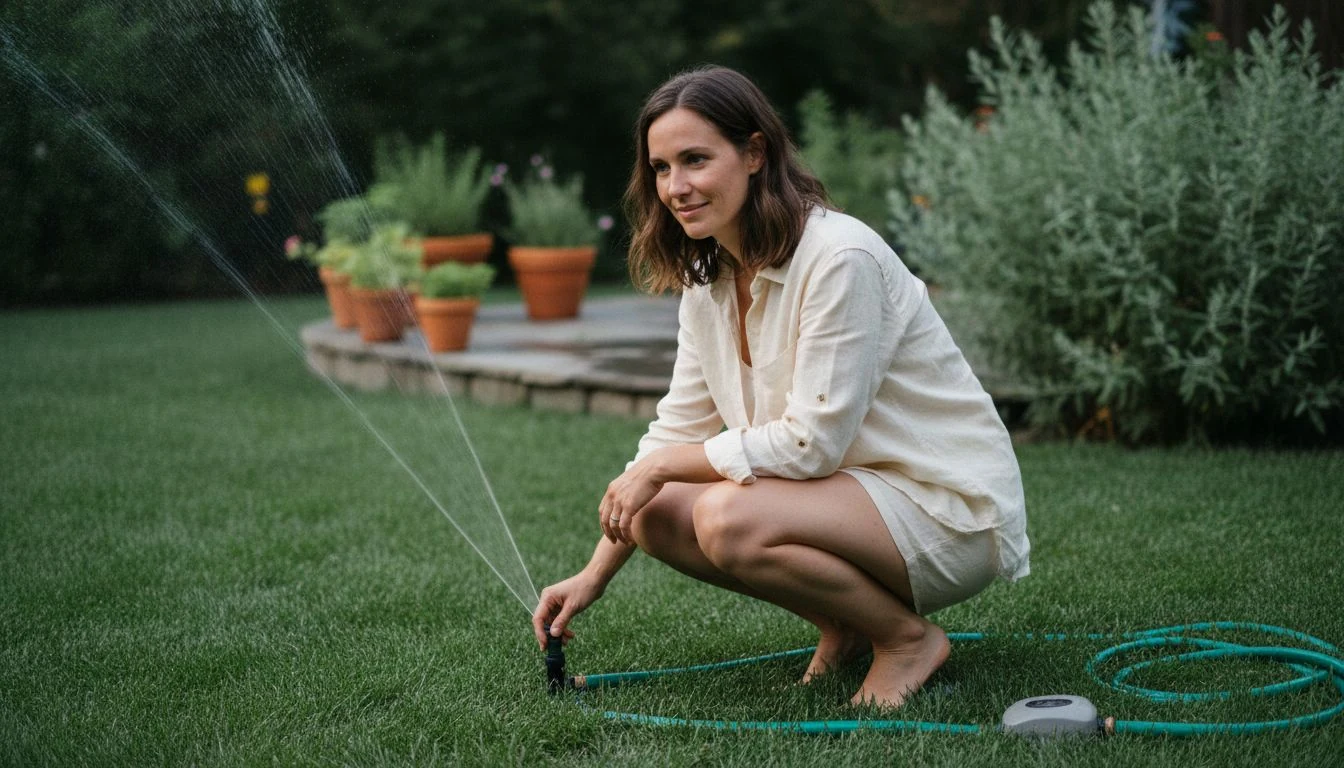
- I fixed my sprinkler schedule. It was running six days a week starting at 1pm. In August. Half of that water was evaporating before it did anything. I moved it to three mornings a week before 7am and the grass looked exactly the same.
- I only ran full loads. Dishwasher and washing machine both. I was running half-empty loads because I wanted one specific shirt. Now there’s a hamper rule and I survive.
- I stopped rinsing dishes before the dishwasher. Scrape, don’t pre-rinse. Modern dishwashers are built for it, and I was basically hand-washing everything twice.
- I put a bucket in the shower. This sounds unhinged but it’s the cheapest habit here. I catch the cold water while it heats up and it waters my plants. Maybe two gallons a day I was pouring down a drain.
Total cost of that list: nine dollars. I keep waiting for the good ways to save on water bill to require a purchase and they mostly just don’t.
Summer is where the bill goes sideways
My winter bills were boring and flat. Then June hit and the number jumped by a third, and I blamed the kids being home, and I was wrong.
Outdoor water is seasonal in a way nothing else in your budget is. You water more, you water in the heat, you fill a kiddie pool, you rinse the driveway because it’s satisfying. And because the bill comes a month later, you never connect the Saturday to the statement.
Three things fixed most of it for me:
- Water early, not midday. Watering before 7am means the water soaks in instead of evaporating off hot grass. Same setting on the timer, more of it reaching the roots.
- Water deeply, fewer days. Three longer sessions beat six short ones. Short daily watering trains shallow roots, which makes the lawn thirstier, which makes you water more. It’s a loop and I was stuck in it.
- Check for outdoor leaks once a season. A cracked hose gasket or a sprinkler head that got run over by a lawnmower can leak the entire time the system runs and you’d never see it from the kitchen window.
If you rent and don’t touch a sprinkler, skip this section entirely and go straight to the toilet. That’s where your money is.
The 10-minute leak check I do twice a year now
If you do one thing off this page, do this one. Ten minutes, no tools, and it’s where I found my money. The EPA’s Fix a Leak Week guidance is where I got the method, and the numbers behind it are wild: household leaks waste nearly 1 trillion gallons of water annually nationwide. The average household’s leaks account for more than 9,300 gallons wasted every year, and nine percent of homes have leaks wasting 50 gallons or more per day.
Fixing the easy ones can cut about 10 percent off a water bill. The check itself:
- The dye test, for toilets. Put a few drops of food coloring in the tank. Don’t flush. Come back in 10 minutes. If there’s color in the bowl, the flapper is leaking. Flush right after so you don’t stain the tank. This is the one that got me.
- The meter test, for everything else. Read your water meter, then don’t use any water for two hours, then read it again. If the number moved, something is leaking somewhere.
- The cold-month sanity check. Look at a January or February bill, when nothing outdoor is running. EPA’s rule of thumb: if a family of four is going over 12,000 gallons a month in a cold month, you likely have a serious leak.
- The touch test, for fittings. Run your hand along faucet bases, under-sink connections, and the pipe fittings in the basement. Any moisture on the outside of a pipe is a leak, even a slow one.
A leak doesn’t feel like an emergency, which is exactly why it bills you for a year.
What I tried that wasn’t worth it
Before I found the flapper, I did what I always do, which is buy something. I spent about $40 on a low-flow shower head with a little pause button because a video told me it would “cut my water bill in half.”
It didn’t. It saved me maybe three or four dollars a month, which is real money and also not my problem. Buying it let me feel like I’d handled things for six more weeks while the toilet kept running.
The other thing I’d skip: those “water saving” faucet aerators sold in four-packs. Most modern faucets already have a perfectly good aerator in them. Unscrew yours and look before you buy a replacement for a part you already own.
And one more, gently. Don’t turn this into a household surveillance project. I tried timing my husband’s showers with my phone for exactly two days and it made us both miserable for about $2 of savings. Fix the hardware, not the humans.
What the EPA’s numbers look like on an actual bill
National stats never landed for me until I converted them into dollars. I ran the arithmetic on a labeled example: a household using EPA’s 300 gallons a day, billed at $6 per 1,000 gallons. Water rates vary enormously by city, anywhere from about $2 to $12 per 1,000 gallons, so run your own rate off your statement. The shape is what matters.
| What EPA measures | The national figure | In this 300-gallon-a-day example | At $6 per 1,000 gallons |
|---|---|---|---|
| Total household use | 300+ gallons/day | ~9,000 gallons/month | ~$54/month |
| Indoor share | ~70% of use | ~6,300 gallons/month | ~$38/month |
| Outdoor share | ~30% (higher in dry states) | ~2,700 gallons/month | ~$16/month |
| Average household leaks | 9,300+ gallons/year | ~775 gallons/month | ~$4.65/month |
| Homes in the leaky 9% | 50+ gallons/day | 1,500+ gallons/month | ~$9/month |
| Fixing the easy leaks | ~10% off the bill | — | ~$5.40/month back |
That outdoor row is the one to stare at. Sixteen dollars a month, and in a hot month with a bad sprinkler schedule it can be double that. That single row is why my summer bill jumped and my winter bill never did.
Three mistakes that quietly ran up my water bill
- Assuming a small bill can’t have a big leak. Mine was “only” $58 in winter, so I never audited it. A leak inside a small bill is still a leak, and it was already running before summer made it obvious.
- Buying the gadget before finding the problem. The $40 shower head answered a question I hadn’t asked yet. Diagnose first, then spend, if you even still need to.
- Ignoring the sprinkler timer because someone else set it. It came with the house. I treated it like a thermostat in a rental, as if the settings were a law. They were a stranger’s guess from years ago.
How the ways to save on water bill fit the rest of your budget
Water is the last utility anyone audits, and I think it’s because the bill is small enough to ignore and confusing enough to avoid. Mine was a $27 a month problem hiding behind a $9 part.
What made it stick was treating it like every other leak in my budget. I did the same walk-through with my electric bill and again with what I was spending on gas, and each one gave back somewhere between $25 and $60 a month. Together that’s real money, and none of it required earning more.
The $27 didn’t go back into general spending, because it would have evaporated the way that money does. It went into a small home-repair sinking fund, which is now the reason a broken garbage disposal is annoying instead of a crisis.
If you want the wider picture of where households actually lose and save money, I keep a running page of budgeting statistics that surprised me more than it should have. And if you’re doing a full sweep, the rest of the small stuff lives in my roundup of money saving tips that work or in the whole saving money section.
Cozy tip: do the food coloring test tonight. It takes ten minutes, costs nothing, and it’s the one thing in this post most likely to find you real money. Then write whatever you save on a line in your budget and give it a job before it wanders off. My free monthly budget printable has a spot for exactly this kind of found money.
Frequently Asked Questions
What are the fastest ways to save on water bill costs?
Check your toilets for leaks first, then look at your outdoor watering schedule. A running toilet flapper is usually a $9 part, and a badly timed sprinkler can be a third of a summer bill. Both are same-day fixes that cost almost nothing.
How do I know if I have a water leak?
Two tests. Put food coloring in your toilet tank and check the bowl 10 minutes later without flushing, and read your water meter before and after two hours of using no water. If either one shows a change, you have a leak somewhere.
Does taking shorter showers actually lower your water bill?
A little, but far less than people expect. About 70 percent of home water use is indoors and showers are only one slice of that. Leaks and outdoor watering usually cost more, so fix those before you start rushing through your mornings.
Why is my water bill so much higher in the summer?
Outdoor use. Nationally about 30 percent of household water goes outside, and that share spikes in hot months with irrigation, pools, and hose use. A sprinkler running midday loses a lot of water to evaporation before it reaches the roots.
How much can I realistically save on my water bill?
Mine dropped from $91 to $64 a month, mostly from one flapper and a timer change. EPA notes that fixing easily corrected household leaks can save roughly 10 percent on a water bill, and outdoor scheduling can save more on top of that in summer.
Grab my free Monthly Budget Template
The same cozy spreadsheet I use to track every dollar — sinking funds, bills, and savings, all in one place. Join the newsletter and I’ll send it straight to your inbox.
No spam, ever. Unsubscribe anytime. — Nora
Keep reading — more on Saving Money