
Meal planning to save money sounds like something a woman with a chalkboard wall and matching glass jars does on a Sunday. Mine happens on the back of a receipt, standing up, in about fifteen minutes.
I resisted it for years because every version I found online was really a lifestyle. Laminated cards. A recipe binder. Seven different dinners so nobody gets bored. I tried that twice, quit both times by Thursday, and went right back to deciding at 6 p.m. what we were eating, which is the most expensive sentence in the English language. What finally worked was smaller and uglier, and it cut my grocery spending from about $520 a month to $385 without a single coupon. Here’s the whole thing.
Why meal planning to save money beats couponing
A coupon saves you 60 cents on something you were probably going to buy anyway. With a plan, you put different things in the cart in the first place. That’s a much bigger lever, and it’s the reason this one habit outperformed every store swap I’ve ever tried.
The plan is not where the savings live. They live in the leaks you stop, and for me there were three:
- The 6 p.m. decision. No plan means takeout or a “quick stop” at the store. My quick stops averaged $31 and never contained only the thing I went in for.
- The optimistic produce. I used to buy vegetables for the woman I intended to become. She never showed up, and $18 of spinach went soft in the drawer every couple of weeks.
- The duplicate pantry. Three jars of cumin. Two half-bags of rice. I was rebuying things I already owned because I had no idea what I owned.
That third one cost me more than I want to admit. The EPA’s From Farm to Kitchen report found wasted food makes up about 24 percent of everything landfilled in the U.S. Some of that is farms and restaurants. A lot of it is us, throwing out groceries we paid for.
Start with the pantry, not the recipe
This is the part that gets skipped, and it’s the part that does the work.
Most meal planning advice starts with inspiration. You browse, you pick things that look good, you write a list of everything those things need. That’s how you end up buying pomegranate molasses for one recipe. Plan the other direction: open the cupboard first, write down what’s already in there, and build the week around emptying it.
I stand in front of the pantry with a pen and write a single line of anchors. Something like: rice, two cans black beans, half box pasta, frozen chicken thighs, tortillas, the sad broccoli. That list is the skeleton of the week. Now I’m only buying the connective tissue, and the connective tissue is cheap.
The first month I did this, my grocery total dropped $94 and I hadn’t changed a single store or brand. I just stopped buying things I already had.
The most expensive ingredient in any recipe is the one already sitting in your cupboard, unused, while you buy another one.
The five-dinner plan that covers seven nights
Seven planned dinners is the trap. It looks responsible and it fails for a boring reason: real weeks have leftovers, late nights, and one evening where somebody eats cereal. Plan seven and you’ll over-buy for at least two of them.
So I plan five and let the other two float:
- Three repeats. Meals we’ve made a hundred times, from memory, with ingredients I can picture. No recipe, no new spice.
- One that stretches. Something that makes six servings out of four servings of protein. Chili, soup, a sheet pan of whatever with rice underneath.
- One flex night. Breakfast for dinner, quesadillas, or the freezer.
- Two unplanned nights. Leftovers from the stretch meal, or the night we go out anyway, which I now budget for instead of pretending it won’t happen.
Variety is the enemy here, and I’ll defend that. Every new dish means new ingredients, and new ingredients mean partial packages that rot. Rotating six or seven dinners you like is not a sad life. It’s how restaurants run a menu.
How to do meal planning to save money in fifteen minutes
Same order every week. It takes me longer to describe it than to do it.
- Check the calendar first. Two nights out this week means I plan three dinners, not five. Planning food for evenings you won’t be home is the single most common way this fails.
- Take stock. Pantry first, then the freezer. Write the anchors on one line.
- Pick the stretch meal. It gets built from whatever anchor is biggest, usually the protein in the freezer.
- Fill in with repeats. Two or three from the standing rotation, chosen by which anchors are left over.
- Write the list from the plan, not from the store. Only what those meals are missing, plus staples you have actually run out of. If it isn’t attached to a meal or a staple, it doesn’t go on the list.
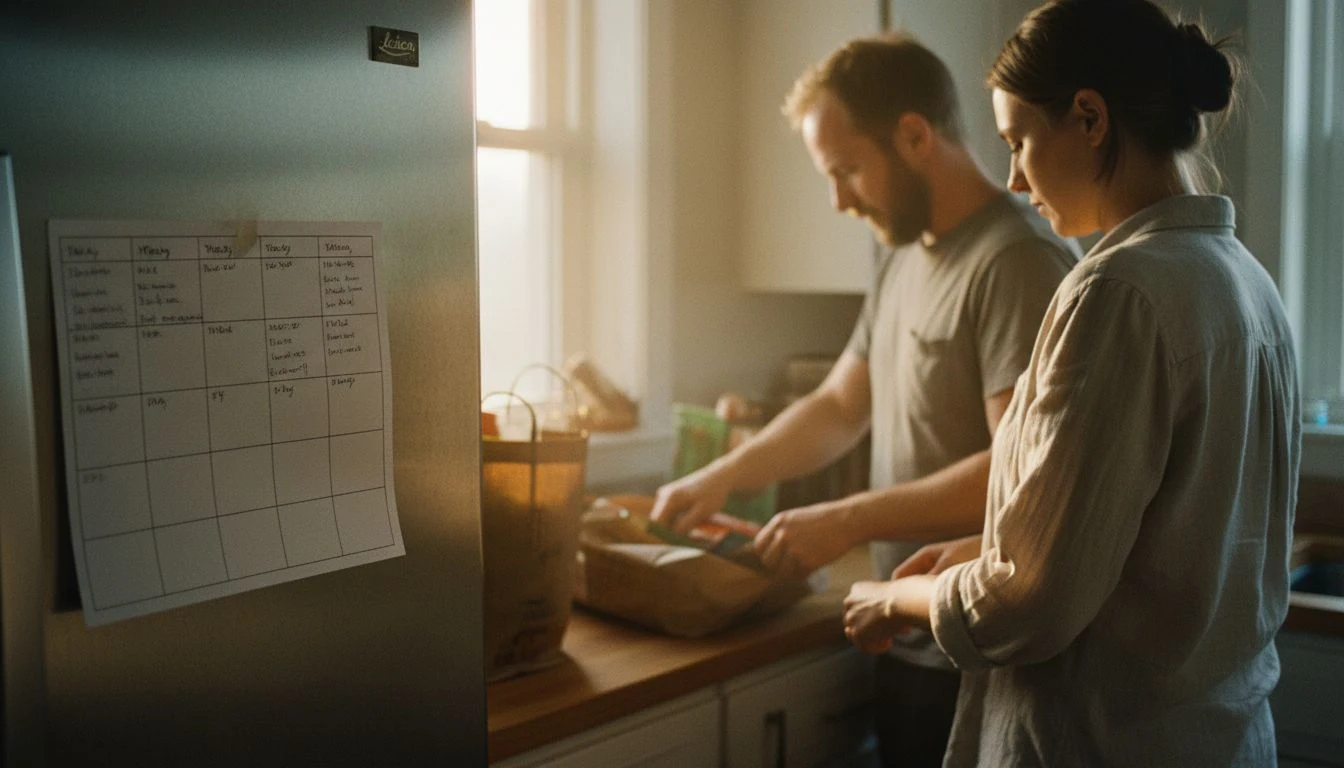
- Put the plan where you’ll see it at 5:30. Mine goes on the fridge. A plan you have to unlock a phone to read is the plan you ignore at the end of a long day.
Step five is the one that saves the money, and it’s the one I got wrong for months. I’d make a beautiful plan and then write my list by walking the store mentally, aisle by aisle, which meant the list grew about $40 of things nobody planned to eat.
Cozy tip: Before you plan anything next week, take a photo of your open pantry and your open freezer on your phone. You’ll shop from those two pictures, and you will not buy the fourth jar of cumin. If you want somewhere to write the plan down, the free monthly budget printable has a blank week grid on the back that works fine for this.
What happens when the plan falls apart on Wednesday
It will. Mine does maybe twice a month, and for a while that was enough to make me quit the whole system.
The fix is having one designated escape hatch that isn’t delivery. In my freezer there are always two things: a bag of frozen dumplings and a pound of ground beef. That’s the Wednesday plan when the actual Wednesday plan dies. It costs about $6 to feed two people and it takes twelve minutes.
Compare that to what a collapsed plan used to cost. Two entrees, delivery fee, service fee, tip: $41 on a Tuesday in March, and I remember it because I looked at the receipt and felt genuinely annoyed at myself. That single habit was costing more per month than my entire produce budget. I wrote more about untangling that reflex in how to stop impulse spending, because for me it was never really about food.
Meal planning to save money when your schedule is unpredictable
If you work rotating shifts or your evenings just refuse to hold still, plan by component instead of by meal. Cook a pot of rice and a tray of protein on your day off. Those two things become bowls or tacos or whatever else, depending on who is home and when. You’re still planning. You’re just not pretending to know what Thursday looks like.
This is also the version I recommend for anyone cooking for one, where a seven-dinner plan almost guarantees waste.
The math: what repeat dinners actually cost per serving
Repeats save money because of unit price. A dinner you make often uses ingredients you buy in the size that’s cheapest, and it doesn’t leave you with two-thirds of a jar of something going hard in the door of the fridge.
Below is a labeled example using typical U.S. supermarket unit prices in mid-2026. Your store will be different, and prices move; the USDA’s Food Price Outlook is updated monthly if you want to see where food-at-home prices are heading. The point isn’t the exact numbers. It’s the gap in the last column.
| Repeat dinner | Cost to make | Servings | Per serving | Takeout equivalent, per serving |
|---|---|---|---|---|
| Black bean and rice bowls | $6.40 | 4 | $1.60 | $11.00 |
| Chili (the stretch meal) | $11.80 | 6 | $1.97 | $9.50 |
| Sheet pan chicken thighs and potatoes | $9.20 | 4 | $2.30 | $14.00 |
| Pasta with jarred sauce and frozen veg | $5.10 | 4 | $1.28 | $13.00 |
| Breakfast for dinner (eggs, toast, fruit) | $4.60 | 4 | $1.15 | $12.00 |
Five dinners, roughly $37 of groceries, 22 servings. That’s the whole argument for planning around repeats instead of novelty.
Three mistakes that make meal planning cost you money
- Planning meals before checking the calendar. Food bought for nights you’re not home is money that goes in the bin. Calendar first, always.
- Choosing recipes with one specialty ingredient each. Five recipes with five orphan ingredients is roughly $25 of jars that will still be in your cupboard next spring.
- Writing the shopping list from the store instead of from the plan. If an item isn’t attached to a planned meal or a shelf that is empty, it isn’t on the list. This is the rule that saved me the most.
If you want the shopping side of this, the store swaps and the apps I keep, that’s all in how to save money on groceries. This post is the planning half. The two together are what took my number down, and you can browse the rest of the saving money posts if you want the other categories tackled the same way. If you’re curious how grocery spending compares across households generally, there’s context in the budgeting statistics roundup.
Frequently Asked Questions
How much money can meal planning actually save?
In my house it was about $135 a month, from roughly $520 down to $385, and most of that came from cutting unplanned store trips and takeout rather than from cheaper ingredients. Your savings depend mostly on how often you currently eat out. If you’re already cooking most nights, expect a smaller drop, mainly from less food waste.
How many meals should I plan for a week?
Five dinners for a household that eats at home most nights, and fewer if your evenings are busy. Planning seven almost always leads to over-buying, because real weeks include leftovers, late nights, and one night nobody cooks. Leave two nights unplanned on purpose.
Do I need a meal planning app?
No. I’ve used a sticky note on the fridge for two years. Apps are fine if you like them, but the plan you can see without unlocking anything is the one you follow at 5:30 on a tired Tuesday.
What if I hate eating the same things every week?
Build a rotation of six or seven dinners you like and swap one out each month instead of planning something new every week. That keeps the unit-price advantage while still giving you change. Novelty is what makes the grocery bill jump, not repetition.
Should I meal plan before or after I check store sales?
Check what’s in your own kitchen first, then the sales, then plan. Sales that decide your plan tend to pull you toward things you weren’t going to cook. Sales that adjust a plan you already made are useful.
Grab my free Monthly Budget Template
The same cozy spreadsheet I use to track every dollar — sinking funds, bills, and savings, all in one place. Join the newsletter and I’ll send it straight to your inbox.
No spam, ever. Unsubscribe anytime. — Nora
Keep reading — more on Saving Money