
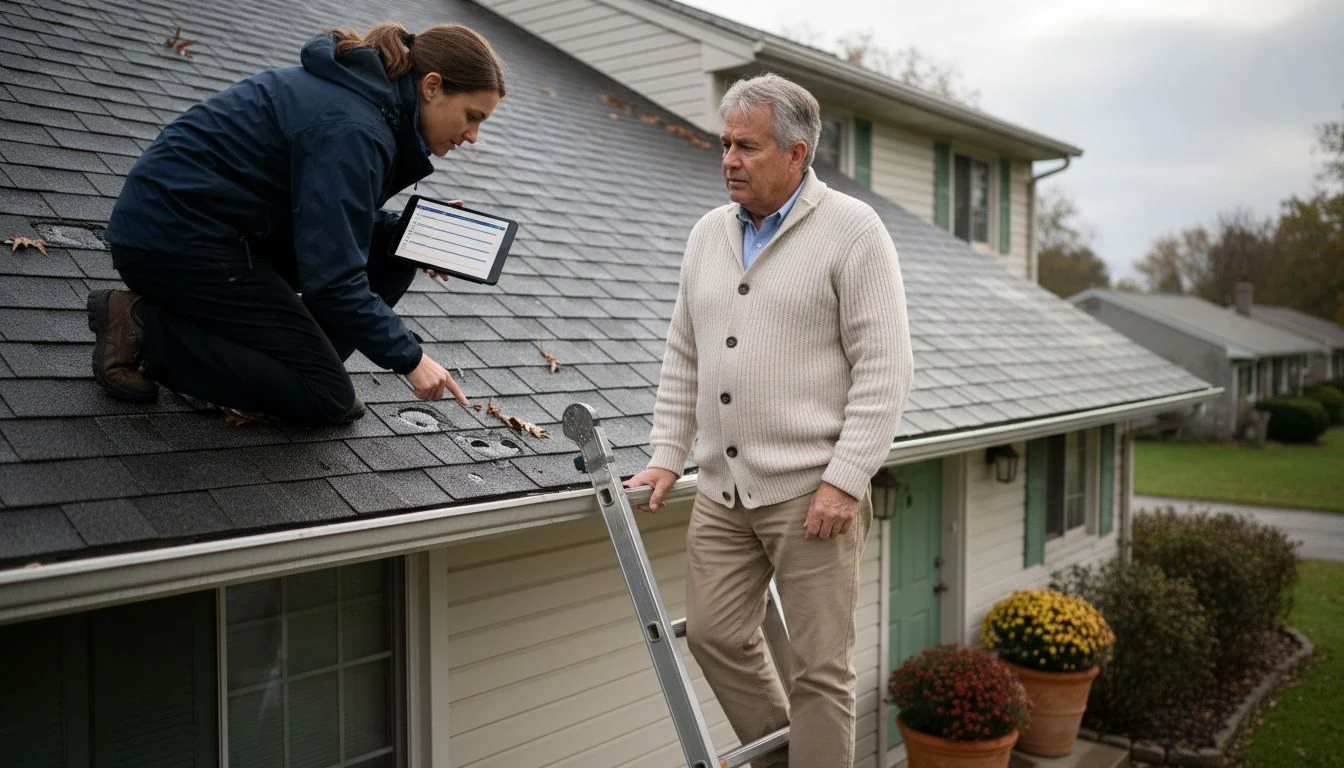
average home insurance cost was a line I got wrong in my house budget for over a year. I had typed in $100 a month because an old article told me so, and I never checked it again.
I still rent. I pay $18 a month for renters insurance, and I’ve been saving for a down payment long enough to have opinions about closing costs. When I finally went looking for the real homeowners number, from the regulators who collect it instead of the sites that want my email for a quote, my $100 guess was off by about $45 a month. That’s $540 a year I hadn’t planned for. Below is the regulator data, the reasons your quote won’t match it, and the way I rebuilt that line in my budget.
The average home insurance cost, straight from the regulators
The number worth trusting comes from the National Association of Insurance Commissioners, the organization state insurance regulators run together. Their homeowners insurance report, published in July 2026, puts the countrywide average premium for a standard HO-3 policy at $1,737 a year, or about $145 a month.
HO-3 is the regular homeowners policy. It covers the house itself against everything except what’s specifically excluded, plus your stuff and your liability. Almost 80% of owner-occupied policies in the country are written on that form, so it’s the fair comparison for most people.
A few other numbers from the same report, because they help you place yourself:
- All owner-occupied policies combined: $1,731 a year, basically the same as HO-3.
- HO-5, the broader “cover everything” form: $1,891 a year, about $158 a month.
- Condo owners (HO-6): $658 a year, roughly $55 a month, since the building is usually covered by the association.
- Renters (HO-4): $173 a year, about $14 a month. Mine runs a little above that.
One honest caveat. That report covers 2023 data. Regulatory numbers are slow, and they are still the best we have. Anyone quoting you a precise national figure for this month is working from their own quote funnel, and you can’t check their math.
Why the average home insurance cost keeps climbing
If you’ve seen people post their renewal letters online in disbelief, these four numbers are why.
In 2019 the same kind of policy averaged $1,272 a year. By 2021 it was $1,411. Then it jumped 11.2% in 2022 to $1,569, and another 10.7% in 2023 to $1,737. That’s roughly 37% in four years, while the house stayed exactly the same house.
The drivers are mostly out of your hands. Claims got bigger: the average homeowners claim paid was $20,062 in 2023, according to ISO data published by the Insurance Information Institute, up from $13,884 in 2019. Rebuilding costs more. Materials cost more. And wind and hail alone caused about 42% of homeowners losses that year.
I used to read renewal horror stories and assume those people had bad luck or old roofs. Mostly they just had a house in the path of the same weather everyone else did.
My takeaway: I treat this line the way I treat utility bills: a fixed cost that drifts upward, so you plan for the drift.
Your state changes the number more than anything you do
The spread between states in the 2023 data is wild. Same policy form, same year:
- Louisiana, the most expensive, at $3,027 a year. That’s about $252 a month.
- Texas at $2,864, and Florida at $2,779.
- Colorado ($2,492) and Oklahoma ($2,486), where hail does a lot of the damage.
- Wisconsin, the cheapest, at $923 a year, around $77 a month.
- Oregon ($1,003), Nevada ($1,013) and Utah ($1,107) round out the low end.
A homeowner in Louisiana pays more than three times what a homeowner in Wisconsin pays, for the same form of coverage. Hurricanes, hail, tornadoes, rebuilding costs and how each state regulates rates all get baked in. No coupon code fixes that.
When I see the average home insurance cost quoted as if it applies to everyone, I mentally tack on “in which state?” If you’re house hunting across state lines, this number deserves a spot on the comparison sheet next to property taxes.
The size of the house matters too, just not how you’d think
Insurers price on what it would cost to rebuild the home, which is called dwelling coverage. That is not the same as the purchase price or the Zillow estimate. Land doesn’t burn down, so it isn’t in there.
This tripped me up. The house price I’d been saving toward is around $320,000, and I assumed that was my coverage amount. It isn’t. Part of that price is the lot. My dwelling coverage would probably land lower, which helps the premium.
Other things that move a quote up or down:
- Roof age and material. An old roof in a hail state can change the quote more than the square footage does.
- Your deductible. Going from $1,000 to $2,500 usually lowers the premium, and it only makes sense if you have $2,500 saved.
- Distance to a fire station and hydrant. The NAIC report calls out fire protection as a real pricing factor, especially for rural homes.
- Claims history on you and on the house itself.
- Features like a wood-burning fireplace or a deck, which the NAIC says can raise costs, versus smoke detectors and security systems, which can earn discounts.
What the average home insurance cost looks like at each coverage level
This is the table I wish I’d had when I typed $100 into my spreadsheet. It uses the NAIC’s 2023 countrywide HO-3 averages, broken out by how much dwelling coverage the policy carried. I added the monthly column and a budget line for a sinking fund with a 10% cushion, which is my own rule of thumb and not something from the report.
| Dwelling coverage | Avg. yearly premium (HO-3) | Per month | Monthly budget line with 10% cushion |
|---|---|---|---|
| Under $150,000 | $954 | $80 | $88 |
| $150,000 to $199,999 | $1,192 | $99 | $109 |
| $200,000 to $224,999 | $1,282 | $107 | $118 |
| $250,000 to $274,999 | $1,350 | $113 | $124 |
| $300,000 to $324,999 | $1,475 | $123 | $135 |
| $350,000 to $399,999 | $1,598 | $133 | $146 |
| $400,000 to $449,999 | $1,679 | $140 | $154 |
| $500,000 to $599,999 | $1,973 | $164 | $181 |
| $700,000 to $999,999 | $2,916 | $243 | $267 |
| $1,000,000 and over | $4,314 | $360 | $395 |
What jumped out at me: the premium doesn’t scale evenly with the house. Going from $150,000 to $400,000 of coverage adds only about $41 a month. The steep part starts past $700,000. If your target home is in the middle of the market, the average home insurance cost for your coverage band is probably lower than the headline $145.
Three mistakes that make this line hurt
- Budgeting from the listing price. I did this. Your coverage is based on rebuild cost, and your premium depends even more on your state and roof, so a national number pulled from a random article is a placeholder at best.
- Forgetting flood isn’t in there. A standard homeowners policy excludes flood, and the NAIC notes earthquake coverage is a separate add-on too. If you’re in a flood zone, that’s a second premium on top of the averages above.
- Picking a high deductible with no cash behind it. A $2,500 deductible saves money only if $2,500 is sitting in savings. Otherwise a claim turns into credit card debt.
How I budget for home insurance before I even own a home
Six steps. I rebuilt my own house budget this way last spring, and it’s the same process I’d use after closing.
- Estimate your dwelling coverage, not the price. Ask a local agent or look at the replacement cost on a comparable listing’s insurance quote. For me that’s somewhere below my $320,000 target price.
- Find your row in the table above. That’s your national starting point. Mine is around $123 to $133 a month.
- Adjust for your state. Divide your state’s average by the national $1,737. In a state near Louisiana’s number, you’d scale up by about 1.7. In Wisconsin, you’d scale down by roughly half.
- Add 10% and treat it as fixed. Premiums have gone up double digits two years running. The cushion means a renewal increase is annoying instead of a crisis.
- Know whether it goes through escrow. Most mortgage lenders collect insurance inside your monthly payment through an escrow account, which the Consumer Financial Protection Bureau explains here. When the premium rises, your mortgage payment rises too, sometimes with a catch-up bill.
- Put the deductible in your emergency fund. Whatever deductible you pick, that amount belongs in your emergency fund the day you close.
My updated line is $140 a month, up from the $100 I’d been using. That sits a bit above the national average home insurance cost for my coverage band, which I’m fine with, because my state isn’t one of the cheap ones. I also moved the difference into my house fund math, which is part of why I’m now saving a little longer than I planned. I’d rather know that now.
If you’re earlier in the process, how I’m saving for a house walks through the full target number, including the costs that sneak up after move-in.
Is the average home insurance cost worth fighting?
Partly. I don’t love the “shop every six months and save $800” advice. It’s usually written by someone who gets paid when you request a quote.
What does move the number: comparing two or three quotes once a year before renewal, bundling if you also carry car insurance (I wrote about what car insurance actually costs if that’s your other big line), raising the deductible once your savings can back it, and asking about discounts for smoke detectors, a newer roof or a security system.
What doesn’t move it: your state, your weather, and rebuilding costs. For those, you plan ahead and move on. It’s the same way I handle every irregular bill on my sinking fund list.
And one thing I’d skip entirely: dropping coverage to fix a tight month. If you have a mortgage, the lender requires it anyway. If you don’t, one kitchen fire can erase years of savings.
Cozy tip: open whatever house budget you have, even a rough one, and replace your insurance guess with your row from the table plus 10%. Then write your state’s multiplier next to it. It takes five minutes. If you want a home for the number, the free monthly budget printable has a fixed-costs section made for lines like this one, and you can find more of these walkthroughs under budgeting.
Frequently Asked Questions
How much is homeowners insurance per month on average?
About $145 a month for a standard HO-3 policy, based on the NAIC’s latest countrywide average of $1,737 a year (2023 data, published July 2026). Depending on your state, the typical range runs from about $77 a month in Wisconsin to about $252 a month in Louisiana.
Why did my home insurance go up so much?
Mostly because it went up for nearly everyone. The average premium rose 11.2% in 2022 and 10.7% in 2023, as claims got more expensive and wind and hail damage kept climbing. Your roof, deductible and claims history matter too, but the state-level trend is usually the biggest piece.
Is homeowners insurance included in my mortgage payment?
Often, yes. Many lenders collect the premium in an escrow account and pay the insurer for you, so it shows up inside your monthly mortgage payment. If the premium increases, the escrow portion of your payment goes up at the next review.
How much home insurance coverage do I need?
Enough to rebuild the house, which is usually different from what you paid for it, since the land isn’t included. In the NAIC data, 55.2% of owner policies were written for coverage between $150,000 and $400,000. A local agent can estimate rebuild cost for your specific home.
Does homeowners insurance cover floods?
No. Standard homeowners policies exclude flood damage, and earthquake coverage is also a separate add-on. If you live somewhere with flood risk, budget for a separate flood policy on top of your regular premium.
If you like seeing the bigger picture, I keep a running page of budgeting statistics built from the same kind of primary sources, and my rent breakdown is the renter version of this whole housing-costs conversation.
Grab my free Monthly Budget Template
The same cozy spreadsheet I use to track every dollar — sinking funds, bills, and savings, all in one place. Join the newsletter and I’ll send it straight to your inbox.
No spam, ever. Unsubscribe anytime. — Nora
Keep reading — more on Budgeting Methods