
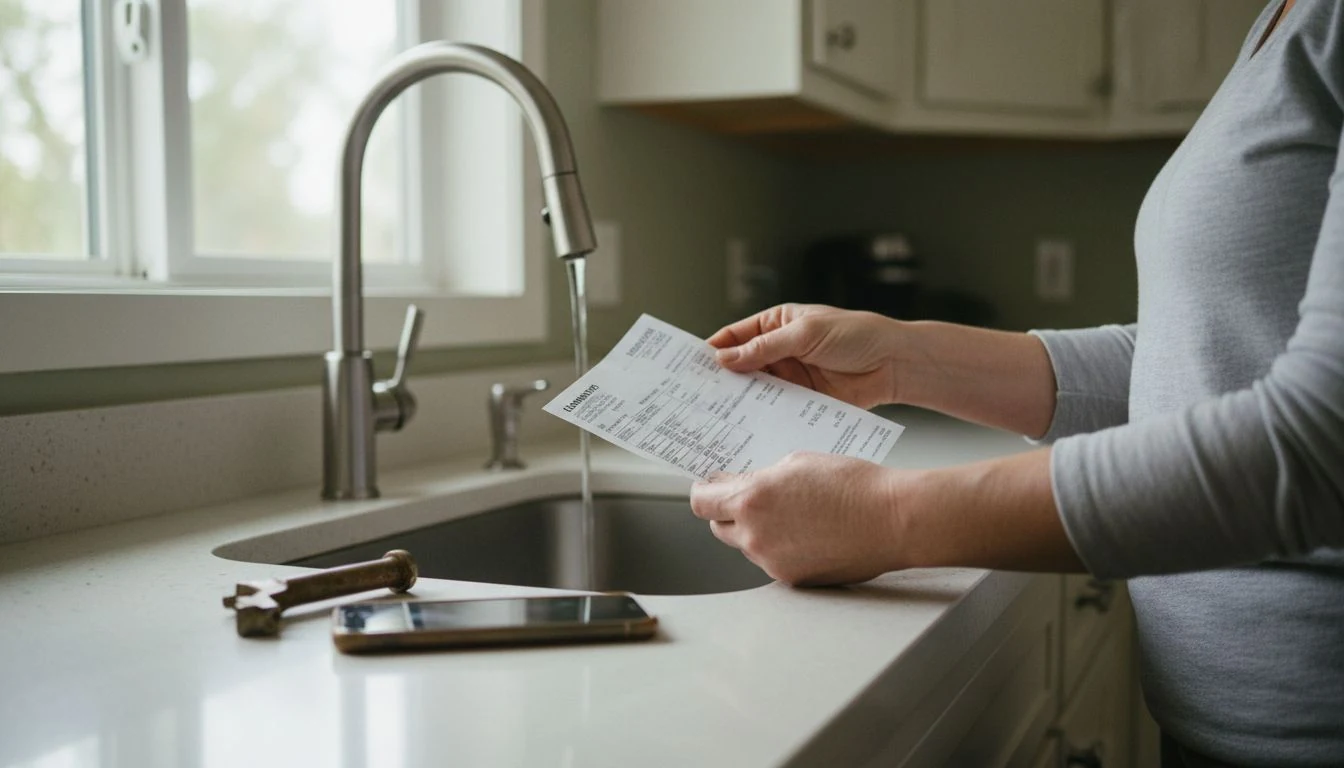
Help paying water bill balances still exists in 2026, even though the main federal water assistance program has run out of money. The best first call is usually your own water utility, and the sooner you make it, the more options you have. If a past-due notice is sitting on your counter right now, please don’t spend tonight feeling bad about it.
You aren’t alone in this. The EPA’s water affordability assessment estimated, on a preliminary basis, that 12.1 million to 19.2 million U.S. households lack affordable access to water services. Below, I’ve put the places to try in the order I’d call them, what to say, what to have in hand, and what to do so next month doesn’t look the same. I’ve had the sick feeling of opening a bill I couldn’t pay, back when I was carrying about $14k in card debt. Calling is the hard part, and it’s usually shorter than you fear.
Help paying water bill costs: what’s changed since the federal program ended
You may run across old articles telling you to apply for LIHWAP, the Low Income Household Water Assistance Program. It was a pandemic-era federal program, and the federal office that ran it now says its funding is no longer available, so households can’t receive benefits through it. The NRDC has written about how that money dried up.
Don’t let a dead link make you think there’s no help left. Assistance now comes from a patchwork: utilities, states, counties, nonprofits and churches. It’s messier than one federal form, and what’s available depends heavily on your ZIP code. That’s why the order of your calls matters when you need help paying water bill charges fast.
For a reality check on your bill, a July 2026 report from doxo, a bill-pay platform, put the median household water and sewer payment at $89 a month, or $1,065 a year, according to WaterWorld. Maryland topped the list at $245 a month. If yours is far above what’s normal for you, skip to the leak section, because you might not have a money problem. You might have a pipe problem.
Where to get help paying water bill debt, in the order I’d call
- Your water utility. The number on your bill. Ask about payment plans, hardship or customer assistance programs, and leak adjustments.
- 211. Dial 2-1-1 or visit 211.org and ask specifically about water bill assistance, shutoff prevention and crisis funds in your county.
- Your local community action agency. These nonprofits often manage emergency utility funds, and 211 can point you to the nearest one.
- Your state or county human services office. Some states run their own water assistance when funding allows, and what’s open changes, so ask what’s available today.
- Local charities and churches. Groups like Salvation Army and Catholic Charities branches may help with one-time bills, depending on their local budget.
- Your landlord, if water is billed through them. Check your lease first, then ask how a late charge works and whether a short plan is possible.
Call in that order because your utility can often pause things while you line up the rest, and many charities want to see that you’ve already talked to the utility. Keep notes as you go: who you spoke with, the date, and what they promised.
You don’t need to explain your whole life. “I can’t pay this full bill by the due date, what are my options?” is a complete sentence.
What to say when you call the water company
This is the script I’d use. Say it before the due date if you can, and read it off the screen if your voice gets shaky:
“Hi, my account number is ____. I can’t pay the full balance of $____ by the due date. I’d like to avoid a shutoff. Do you have a payment plan, or a hardship or customer assistance program? Can you put a hold on any disconnection while I apply? And can you waive the late fee?”
Then stop talking and let them answer. Before you hang up, ask three more things:
- What’s the exact date my service could be shut off, if anything?
- What will the monthly payment be under this plan, on top of my regular bill?
- Can you send that in writing? An email or letter protects you if anyone disputes it later.
Be realistic when you agree to a plan. A number you can make every month beats a bigger number you’ll miss in eight weeks. If they offer $60 a month on top of your bill and you know you’ve only got $35, say so and ask what else they can do.
Check for a leak before you assume the bill is the problem
If your bill jumped and your habits didn’t, look for a leak. The EPA’s WaterSense program says the average family can lose about 9,400 gallons a year to household leaks. A running toilet is the classic culprit, and it doesn’t make much noise while it runs up your bill.
- Do the meter test. Turn off every faucet and appliance, note the meter reading, wait a couple of hours without using water, and read it again. If it moved, water’s going somewhere.
- Do the toilet test. Drop food coloring in the tank and wait 15 minutes without flushing. Color in the bowl means a leak.
- Ask about a leak adjustment. Many utilities reduce a bill after you fix a documented leak. Rules vary, so ask what proof they want, and save the plumber’s receipt or a photo of the part.
My post on ways to save on your water bill goes deeper on the fixes, ranked by how much they can save.
Cozy tip: Once the crisis passes, give water its own small line in your budget. Divide last year’s total by 12 and set it aside on payday, since summer bills can jump. Our free budget printable has a bills page that makes this easy to start tonight.
What to have ready before you ask for help paying water bill balances
Most programs want proof before they release money. Pulling this together once saves you from restarting the same phone call four times. Requirements vary, but this is a good starter folder:
| Who you’re calling | What they can usually do | Have this ready | Ask this exact question |
|---|---|---|---|
| Water utility | Payment plan, late-fee waiver, shutoff hold, leak adjustment, hardship program | Account number, latest bill, an amount you can truly pay | “Can you hold disconnection while I apply for help?” |
| 211 | Referrals to open local funds | ZIP code, past-due amount, shutoff date | “Which funds in my county have water money right now?” |
| Community action agency | Emergency utility aid or referrals | ID, proof of income, proof of address, shutoff notice | “What’s your income limit, and how long does a decision take?” |
| State or county human services | State-funded aid or crisis grants when open | ID, income proof, household size, recent bill | “Is any water or crisis assistance open today?” |
| Charity or church | One-time payment toward a bill | Shutoff notice and what the utility offered | “Do you pay the utility directly, and how soon?” |
Common mistakes when asking for water bill help
- Waiting for the shutoff notice. You’ll usually have more options, and less fee pressure, if you call before the due date.
- Agreeing to a payment you can’t keep. A broken plan can leave you worse off, so ask for the amount you can make through the slow months.
- Applying through a random website. Real assistance doesn’t need your card number or an application fee. Start from your bill’s phone number or 211.
If you’ve got a shutoff notice right now
Same-day problem, same-day plan. Call the utility as soon as they open, say you’ve got a disconnection notice, give the date on it, and ask what amount stops the shutoff. Sometimes it’s less than the full balance.
Then call 211 and say the word “shutoff” up front. Crisis funds move differently from regular ones. If someone in your home has a serious medical condition, or you have an infant or an older relative at home, tell both of them. Protections differ by state and utility, so I can’t promise what applies to you, but it’s worth raising. Your state’s public utility commission or local legal aid office can explain your rights if something seems off, though not every water system answers to the same regulator.
Paying your water bill on a credit card to stop a shutoff is a last resort. Ask about a convenience fee, and treat the balance as debt to clear first. My guide to paying off debt on a low income can help with what comes next.
How to keep it from happening next month
Getting caught up is step one. Staying caught up is where a budget earns its keep. Start by checking the rest of your bills, because if water got behind, something else might be close. If energy bills are part of the squeeze, the Home Energy Assistance Program is a separate program and worth a look. My average utility bill breakdown can help you spot which line is running high.
Then try these:
- Ask about budget billing. Some utilities will average your usage across the year so summer doesn’t spike. Not all offer it, but it’s a quick question.
- Move the due date. Ask whether it can land right after payday, since a date mismatch can be half the trouble.
- Build a tiny bill buffer. Even $10 per paycheck helps. A small emergency fund is what turns next year’s surprise into an annoyance.
I also keep a running list of budgeting statistics if you want to see how common money stress is, and there’s more help like this in our saving money section.
Frequently Asked Questions
Is there a government program to help pay water bills?
The federal LIHWAP program no longer has funding, so it can’t provide benefits now. Some states, counties and cities run their own assistance when money is available. Call 211 or your state human services office and ask what’s open today.
Who can help me pay my water bill today?
Start with your water utility, which may offer a payment plan or a shutoff hold. Then call 211 and ask for crisis funds in your county, and try your local community action agency. Help isn’t guaranteed the same day, so ask about timing right away.
Can the water company shut off my water for not paying?
Yes, it can happen, but rules on notice and protections vary by state and utility. Call as soon as you get a notice and ask for the exact date and the amount needed to stop it. Local legal aid can explain your rights.
Does LIHEAP pay for water bills?
LIHEAP is built for home energy costs like heating and cooling, so don’t count on it for water. It can still free up room in your budget if your energy bills qualify. Ask your local LIHEAP office about what it covers where you live.
Can I get a water bill reduced because of a leak?
Many utilities offer a one-time leak adjustment after you fix the problem and show proof, like a plumber’s receipt. Rules differ, so call and ask what they need. It’s worth checking if your bill spiked without any change in how you use water.
Grab my free Monthly Budget Template
The same cozy spreadsheet I use to track every dollar — sinking funds, bills, and savings, all in one place. Join the newsletter and I’ll send it straight to your inbox.
No spam, ever. Unsubscribe anytime. — Nora
Keep reading — more on Saving Money